
Tagalog to English Translation for Documents, Feedback and Calls
Etranslation turns Tagalog documents and messages into accurate English, and recordings too. Filipino linguists in the Philippines read the original, a proofreader compares source and translation, and certified output is available for official use. The hard parts are Taglish, politeness markers, handwriting plus name spellings, not vocabulary.
Most people who ask for tagalog to english translation already have the Tagalog in hand. A birth record for a visa file, a stack of customer comments, a contract signed in Quezon City, a voice note from a relative. The English has to be right, and “close enough” can cost you a rejected application or a misread complaint. Here’s who usually needs this, where Tagalog trips up software and tired humans alike, and what to have ready before you ask for a quote.
Who needs Tagalog turned into English
The Philippine Statistics Authority’s 2020 census release on home languages reports Tagalog as the language generally spoken at home in about 39.9 percent of households. So a huge amount of paperwork and correspondence starts there, along with online conversation, and sooner or later someone abroad needs to read it.
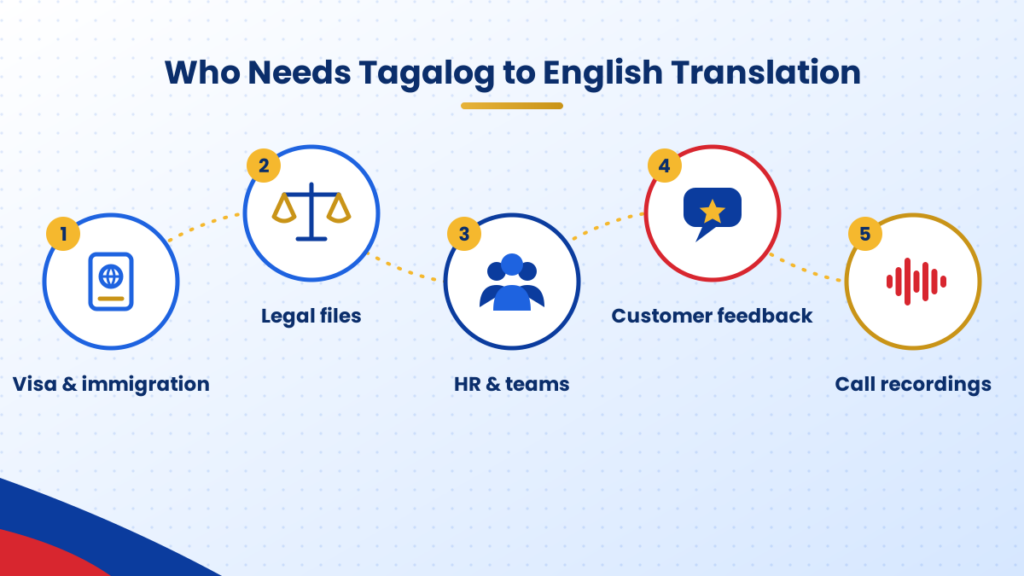
Our requests tend to fall into five groups:
• Immigration and visa applicants with civil records, affidavits, police clearances or letters of support.
• Law firms and in-house teams handling contracts, demand letters, sworn statements and court filings written partly or fully in Tagalog.
• Companies with Filipino staff or partners who need HR notices and meeting notes in English.
• Brands and researchers reading social media posts, reviews, survey answers and support tickets.
• Call centers and support teams reviewing recorded calls or chat logs for quality and compliance.
Civil records deserve their own mention. If it’s a birth certificate, go to our page on PSA birth certificate translation.
Taglish and code-switching
Real Filipino writing rarely stays in one language. A text message might say “Pwede po bang i-reschedule yung meeting kasi may emergency sa office?” Half of it is English already, so a translator can’t just convert the rest.
Good English output keeps both the meaning and the register of the original, so a polite request from a worried customer doesn’t quietly turn into an order barked at a support agent.
Mixed sentences hide traps. “Okay lang” can mean fine, or it can mean not fine at all, depending on the speaker. Context decides, which is exactly why we ask where a message came from and who wrote it before we commit to one reading.
Regional speech, informal writing and honorifics
Manila Tagalog is the version most people picture. But Batangas and Quezon have their own vocabulary and rhythm, and speakers from other regions often write a second-language Tagalog mixed with Cebuano, Ilocano or Hiligaynon words.
Social media is harder. Spellings get shortened (“di ko alam” becomes “dko alam”), slang changes monthly, and jokes lean on wordplay that dies in a literal swap. We’d rather give plain English with a short note than invent a joke.
Then there are po and opo, small markers of respect. English has no matching word, so a good translator carries that respect through phrasing, such as “please” or “sir”, or by noting it when it matters. A message without po sent to a stranger tells you something. A message full of it tells you something else, and in a legal or complaint context that signal can change how the writer comes across, so we flag it whenever it carries weight.
The Komisyon sa Wikang Filipino is the national language regulator, and its published guidance is a useful reference for standard Filipino spelling. Casual writing breaks those rules constantly, so the translator has to read what the writer meant.
Names, places and handwriting
Names cause more rejected files than grammar ever will, in our experience, because a reviewer at a visa desk can spot a one-letter mismatch in seconds and grammar they never check. Filipino naming has quirks: a mother’s maiden name as the middle name, suffixes like Jr. and III, the Spanish particles “de” and “del”, and the occasional ñ that gets flattened to n in one record but not in another. Place names are similar: “Sta. Cruz” and “Santa Cruz” can both be correct.
Our rule is simple: we transliterate names exactly as the source writes them, and we ask for your passport spelling if you have it, since that’s usually the version every other document in your file will follow. When two documents disagree, we tell you and don’t pick a winner quietly.
Handwriting is its own problem. Old registry entries, signed affidavits and clinic notes get photographed at an angle with a thumb in the corner. We read what’s legible and mark what isn’t, for example “[illegible]” or “[stamp unclear]”, so the English never claims more than the page shows. Cropped scans lose text for good.
Customer messages, feedback and call recordings
Tone is the job. Someone writes “Grabe naman kayo” after a delayed order. Word for word that’s close to “You’re terrible”, but in context it may be a weary, half-joking complaint or a genuine insult, and a flat English rendering can make a mild customer sound furious, or make an angry one sound perfectly calm, which is how real complaints get ignored.
Tell us what you’ll do with the results. A sentiment study needs consistent handling of sarcasm and intensity words, while a refund dispute needs close reading of every sentence. Same Tagalog, different care.
Audio adds a step. Calls and voice messages are typed up in Tagalog first, which our transcription service handles, and then translated. Skipping the transcript leaves you nothing to check the English against.
Machine translation or a human linguist?
Machine tools are fine for getting the gist of a Facebook comment. But they’re shaky on exactly the things above: Taglish, particles like “naman” and “lang”, sarcasm, shortened spellings and proper names. They also tend to sound sure of themselves when they’re wrong, which is the dangerous part.
| Situation | Machine output alone | Human linguist |
| Understanding a casual post | Usually enough for the gist | Only if the tone matters |
| Visa or court document | Risky; names and dates can drift | Needed, plus a signed certificate where required |
| Customer complaint review | Misses sarcasm and intensity | Needed for anything you’ll act on |
| Handwritten record | Often fails to read it | Reads and marks unclear parts |
Honestly? For big volumes, mix them: machine for sorting, people for anything that carries consequences, and nobody should have to pretend the first pass is final.
How we review the work, and what to prepare
A Filipino linguist translates the Tagalog. A proofreader then compares source and translation line by line, looking for omissions, spelling slips and anything ambiguous. That second pass follows the same logic as ISO 17100, the international standard for translation services, which expects a translation to be checked by someone other than the person who wrote it. For official files we attach a certificate of accuracy, and our page on certified translation explains what that does and doesn’t cover.
Before you ask for a quote, run through this list:
• Full scans or photos, every page, with no cropped edges.
• The purpose: visa, court, internal review, publication.
• Passport spellings for every person named.
• Any glossary, product names or terms that must stay in Tagalog or English.
• The receiving office’s written requirements, if there are any.
We send a quotation in under an hour after we receive your files. Results come as a PDF, a hard copy or both. For background, see the Tagalog language page. Ready to start? Send your files through the quote form.
Why choose Etranslation for Tagalog to English work
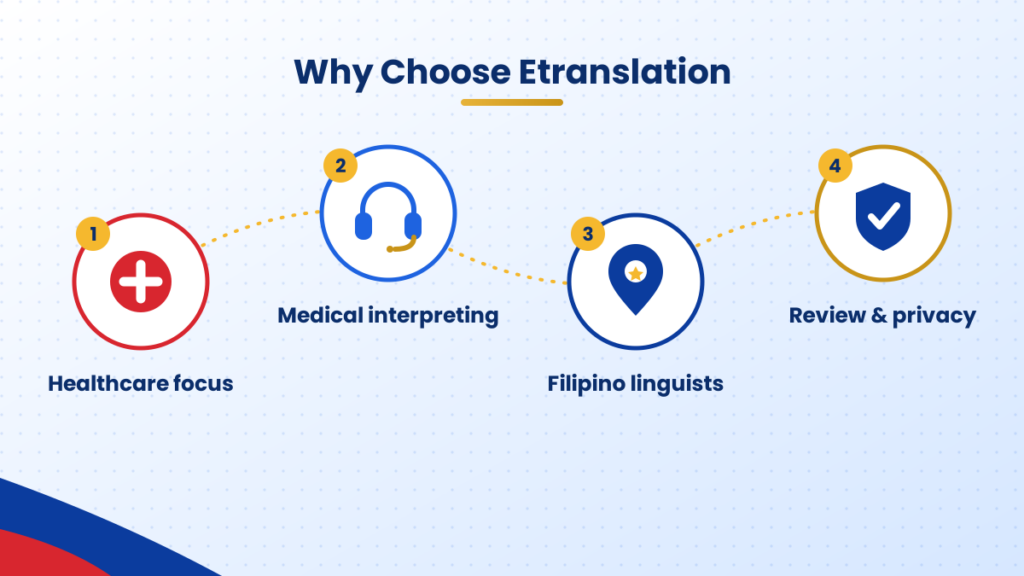
Tagalog gets read in Manila every day, and that matters more than it sounds. Our linguists live and work in the Philippines, so Taglish, regional spellings and the way people really write online aren’t things they look up. They already know them.
Nobody marks their own homework here. A proofreader checks your source against the English before anything goes out, which catches the dropped sentence or the swapped digit a translator can’t see in their own text. For tagalog to english translation that has to hold up at a visa desk or in a dispute, that second pair of eyes is often the difference between a file that moves and one that comes back.
What you get with every order:
- A signed certificate of accuracy for official files, issued by Arthur William Eyango, CEO and Registered Translator and Interpreter.
- A QR code on the certificate. Lose the original and you can download it again from the TranslatorsHub page.
- A written quotation in under an hour once we have your files.
- Your translation as a PDF, a hard copy or both.
- Cover for 89 languages and 210 variants, so a file that later needs a second language stays with one team.
Questions before you send anything? Message us on WhatsApp at +63 928 268 2435 and we’ll tell you what we need to quote it.
Frequently asked questions
Can you translate Taglish text into English?
Yes, routinely. Mixed Tagalog and English is normal in Filipino messages and speech, so our linguists read it as one language, not two. We keep the meaning and the politeness level, and the original English words stay where they carry a specific sense. If a phrase could be read two ways, we flag it and ask you for context before we guess.
Do you translate handwritten Tagalog documents?
We do, with care. Send a clear, uncropped scan of each page, front and back where there’s writing on both. We translate what we can read and mark anything illegible or smudged, smudged or covered by a stamp instead of filling the gap.
Will you keep po and opo in the English version?
Not as words, since English has no true equivalent for them. We carry the respect through phrasing, such as a formal address or “please”, and add a note when the politeness level matters, as in a complaint or a legal statement.
Is machine translation good enough for Tagalog?
For understanding a casual comment, often yes. For visas, contracts or customer complaints, no. Software struggles with Taglish, sarcasm, shortened spellings and names, and it can sound confident while being wrong. We suggest human review for anything you plan to rely on.
Can you translate Tagalog voice recordings and calls?
Yes. We transcribe the Tagalog first, as a written record,, then translate it, so you get a written record you can check. Tell us about audio quality, the number of speakers, and if you need timestamps. Background noise and overlapping voices change how the work is planned.
How do names get handled in Tagalog to English work?
We copy names exactly as the source spells them and ask for passport spellings when you have them. If the same person appears with different spellings across documents, we point that out rather than choose one. Matching names across your whole file is usually what keeps applications moving.
No responses yet