PSA Birth Certificate Translation for Visas, Petitions and School Abroad
Etranslation translates PSA-issued certificates of birth, marriage or death, plus CENOMAR records, with every field rendered alongside any annotations and marginal notes, and each stamp described. Names are matched to your passport spelling, and a signed certificate of accuracy goes with the translation. Apostille and notarization are separate steps with other providers.
Getting a psa birth certificate translation done sounds simple until the document in your hands has a pencilled annotation, a late-registration remark or a mother’s maiden name spelled two different ways. Etranslation is based in the Philippines, and the linguists we work with read these records every week. Below you’ll find what we render on a PSA certificate, why spelling has to match your passport, how a certified translation, a notarization and an apostille differ, and what to send so the quote comes back without a round of questions about unreadable scans.
Which PSA documents we translate
The Philippine Statistics Authority issues certified copies of civil registry records. Four of them cover almost every request we get:
• Birth certificates, the one almost everybody needs first.
• Marriage certificates, often for a spouse or family petition.
• Death certificates, usually for inheritance, insurance or a pension claim.
• CENOMAR, the certificate of no marriage record, which foreign offices ask for before a wedding abroad.
PSA prints these on security paper. In its own announcement about the system, the agency lists features such as a QR code on every page and a reference number tied to each record. That matters to you in one practical way: a photocopy of a photocopy won’t do. Scan the paper you were issued, not a screenshot.
Local civil registrar copies are a different animal, because the older ones can be handwritten, in Spanish or in Tagalog, with ink that has faded and stamps that overlap the text, and we translate those as well, as long as the scan is readable.
What the translator actually renders
It isn’t just the typed boxes. A proper translation covers everything on the sheet, and that’s where a quick online tool usually falls apart.
• Every field: names, dates, place of birth, parents’ details, registry numbers, the registrar’s name.
• Annotations and marginal notes, such as a court-ordered correction or a change of first name.
• Late registration remarks, which tell a reader the birth was recorded well after it happened.
• Stamps and seals, plus signatures, described in brackets so the reader knows what each one is.
• Anything illegible. We say so in a bracketed note instead of guessing.
Dates need care. Philippine records can write a date out in words, while the receiving country may expect numbers, and day-month order flips between countries. Our rule is simple: keep the source wording visible and make the format unambiguous.
Why names have to match your passport
Here’s the failure we see most. The passport says “Ma. Cristina Dela Cruz”, the birth certificate says “Maria Cristina de la Cruz”, and the translation quietly picks one. An immigration officer sees a mismatch and asks for more evidence. Weeks gone.
Names get tricky in specific places: “Ma.” for Maria, a spaced or unspaced “Dela” or “De la”, a middle name that is really the mother’s maiden surname, a suffix like Jr. or III. Honestly, the best fix is cheap: tell us up front which spelling the receiving office already has on file, and send a passport page with your documents so we can see the difference before we start typing anything.
We follow the source document letter for letter. If it conflicts with your passport, we don’t fix it. We flag it, add a translator’s note if you want one, and you decide whether the record itself needs a correction through the civil registry. Silently “correcting” a name in translation is the one thing a translator shouldn’t do.
Certified, notarized or apostilled
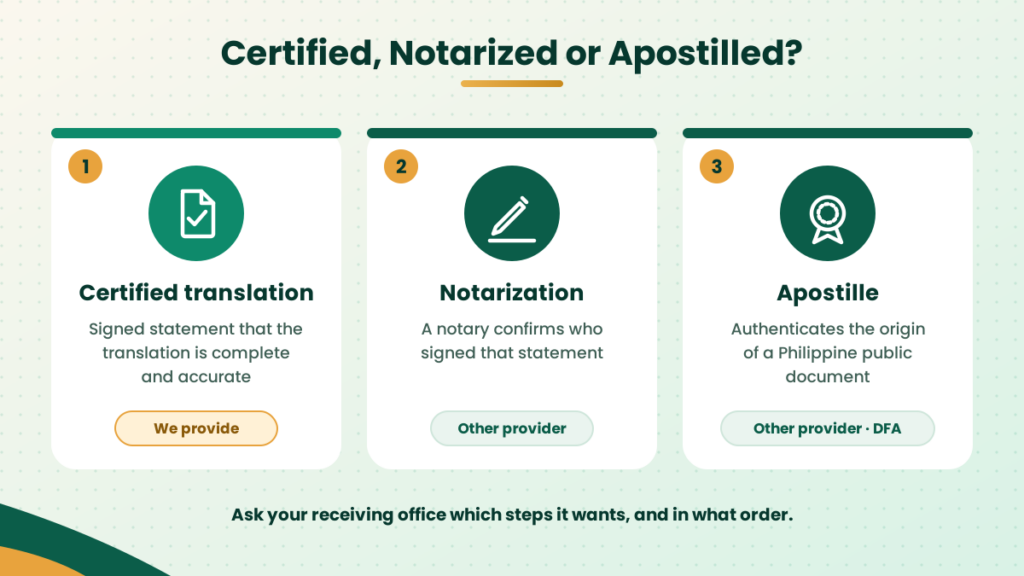
Three terms, three jobs, and offices mix them up constantly. At a high level: a certified translation carries a signed statement that it’s complete and accurate. Notarization has a notary confirm who signed that statement. An apostille authenticates the origin of a Philippine public document for use in another country that belongs to the convention.
The full side-by-side lives on our certified translation page, so we won’t repeat it. What matters here is order of operations. The apostille is attached to the Philippine document itself. The Department of Foreign Affairs explains in its apostille FAQ which documents qualify and how the process runs. Ask your receiving office whether it wants the apostille before or after the translation, since some want both on the same set.
Etranslation supplies the translation and the certificate of accuracy, signed by Arthur William Eyango (CEO, Registered Translator and Interpreter). Notarization and apostille come from other providers. We’ll tell you that plainly rather than imply it’s all in one package.
Where these translations get used
Visa applications are the big one. A tourist or student visa file may need nothing more than a birth certificate to prove age and parentage, but a spouse or family petition can pull in the birth certificate, marriage certificate and CENOMAR together. Schools abroad want one too. Foreign marriages usually need a CENOMAR plus a birth certificate.
Death certificates show up in estate cases and pension claims, where a dead person’s name has to line up with bank records, land titles and old IDs that were never updated, so the same care with spelling applies even though the stakes feel different.
Whether an embassy, school or registry will accept a given translation is its own decision, and we can’t promise that in advance and won’t try. What we can do is follow the written instructions the office gave you, which is why it pays to ask for them first and send them along with the scans. Need the English side of a foreign document going the other way? That’s our Tagalog to English translation work.
What to send for a clean quote
Bad scans cause more delays than hard documents.
• The full page with all four corners visible. A scan cropped at the edge hides registry numbers.
• Both sides, if there’s printing or a stamp on the back.
• Colour, not black and white. Faded annotations vanish in greyscale.
• Flat and square to the camera. No shadows, no glare across the text.
• A passport photo page, so names can be matched.
• The destination country and purpose, plus any written requirements from the receiving office.
• Your deadline, including time for any notary or apostille step.
Once your files arrive we check the pages, count the words and get a quotation back inside the hour. Before sign-off, a proofreader reads the translation against the source, field by field, because one transposed digit in a registry number is easy to miss and hard to explain later. You get the finished set as a PDF, a hard copy or both, and the certificate carries a QR code, so you can download it again from our TranslatorsHub page.
Several documents in one batch? Our document translation service keeps names consistent across the whole set. Ready? Send the scans through the quote form.
Frequently asked questions
Do you translate PSA birth certificates with annotations?
Yes. Annotations and marginal notes get translated along with the printed fields, court-ordered corrections and late-registration remarks included, while stamps are described in brackets. If part of a note is illegible, we mark it as illegible rather than guess. Send the whole page so nothing on the margins is cut off.
Does the translation have to match my passport spelling?
The translation has to match the source certificate, letter for letter. If that conflicts with your passport, we flag the difference and can add a translator’s note. Whether the record itself needs correcting is a question for the civil registry and the office that asked for the document.
Can you translate a CENOMAR?
Yes, along with marriage and death certificates. A CENOMAR is short, but the wording is formal and the dates and names must be exact. Tell us where it’s going, for example a foreign marriage registry, so we can follow any wording that office has asked for.
Do I need an apostille on my PSA certificate?
Sometimes. It depends on the country and office receiving the document. The apostille goes on the Philippine public document through the Department of Foreign Affairs, not on our translation. Read the DFA apostille FAQ, then ask the receiving office what order it wants things in.
What scan quality do you need?
A flat colour scan or sharp photo of the full page, with all four corners and any back side visible. Avoid shadows and glare, and don’t crop the edges. If the document came on security paper, scan that copy and not a photo of a screen.
Will an embassy accept your translation?
That’s the embassy’s decision, and we don’t claim any embassy accepts our work in advance. Get the office’s written translation rules and attach them to your order, then we’ll format the translation and certificate to match wherever that’s possible. Rules differ from office to office, so it’s worth checking early.
No responses yet