
Medical Translation Philippines for Patient Records, Consent Forms and Healthcare Content
Medical translation moves clinical and patient-facing text into another language without altering what it says. Etranslation translates patient records, consent forms, discharge instructions and healthcare content, with close attention to terminology and confidentiality, and we offer interpreting for appointments and meetings. This page is not medical advice. It only describes our services.
One wrong dose or a swapped unit can change how someone is treated. So the medical translation Philippines hospitals and clinics, NGOs, even families ask for is a different job from translating a brochure, and Etranslation works with healthcare clients, has interpreting experience in medical settings, and translates between English and Tagalog as well as many other languages. Below: the documents we handle, how we keep them accurate and private, and where interpreting fits in.
What medical translation covers
Medical files fail in different ways. The table shows where each type tends to slip and what helps.
| Document type | Common risks | What helps |
| Patient records and summaries | Abbreviations, dates and units misread; privacy | Clear source files, an abbreviation list, confidential handling |
| Consent forms | Legal and clinical wording that readers must understand | Plain language target text, review by the issuing institution |
| Discharge and medication instructions | Dose, frequency and units changed or misread | Number checks, a glossary, clinician sign-off |
| Patient information leaflets | Terms too technical for patients | An audience brief and plain-language review |
| Questionnaires and surveys | Questions that change meaning in translation | Careful wording and, where needed, back-translation |
| Health campaigns and training material | Tone, cultural fit and reading level | Native linguist review and audience testing |
Healthcare websites, patient portals, NGO health programs and staff training guides are fair game too. Do the papers also need certifying for an agency or embassy? Start with our certified translation guide.
What this page is not
This page describes a language service, nothing more. It doesn’t give medical advice, diagnose anything or recommend treatment, and a translator can’t stand in for a clinician. Source text is what we translate. The doctor, hospital or organization that issued the document stays responsible for the clinical content, and we make no claim here of HIPAA compliance or regulatory approval.
Accuracy and terminology
Medical text is packed with abbreviations and units, and the vocabulary has no room for near-misses. A translator has to separate look-alike terms, know how doses get written, and know what a drug is called in the target country. Sometimes several wordings are all correct (a Tagalog term, an English loanword, the Latin name), so the right pick depends on who’s going to read it.
Terminology runs on a glossary. Got preferred terms? Send them. If you haven’t, we’ll build a list from your first documents and reuse it so file ten matches file one, which saves you from repeating the same correction every time a drug name or unit turns up again. Names, numbers, dates, units, drug names: each gets its own check against the source, because those small slips do the most damage.
ISO 17100 is the standard for translation services. It covers processes and resources, and it expects a second qualified person to review the work. Our process follows that idea. Someone other than the translator reviews every medical file before it reaches you.
Confidentiality and data privacy
Medical documents carry personal data, often the most sensitive kind. In the Philippines the National Privacy Commission oversees the Data Privacy Act of 2012, which governs how personal information gets handled. Sending patient data? Put a few questions to any provider. Who can see the files? How are they sent and stored? What happens when the project is over?
Etranslation handles healthcare documents under confidentiality rules. Can you strip out names or identifiers before sending? Please do, since anonymized files lower the risk for everyone involved, you included.
Interpreting support for healthcare
Paper is only half of it. Patients and providers have to talk too, and Etranslation has interpreting experience in medical settings, including Tagalog as well as Arabic and French. Our interpretation services page lists the modes on offer, while telehealth and online consultations are covered on the remote interpreting page.
Handing the job to a bilingual relative or a staff member is tempting. The American Translators Association says bilingual does not mean qualified. Its guidance warns that untrained interpreters, children especially, may lack the vocabulary and training for accurate medical communication, whereas professional interpreters are bound by ethics to convey everything that’s said. For long documents, it adds, a written translation serves better than sight translation on the spot.
How a medical translation project runs
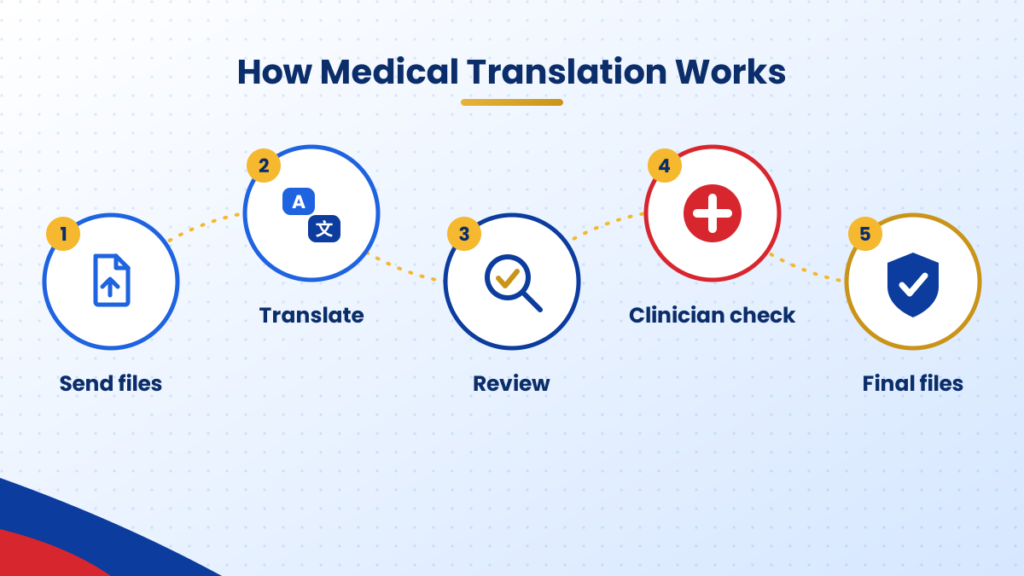
1. Send the files, the languages and what the translation is for. Strip names where you can.
2. Next, a look at file type and length, the subject, any special terms. Scope and price come back in writing.
3. A linguist translates into their native language.
4. A second person compares translation against source, with extra attention on names, numbers, units, dates.
5. Your clinician or issuing team reviews terms and wording where needed, and we update the file.
6. Final files arrive in the format you agreed.
Don’t skip the review by your own clinical staff. Judging clinical accuracy isn’t something we can do for you; what we can do is check that the translation matches the source and that the terms stay consistent from the first page to the last.
What to prepare
• The final, approved source version. Drafts change, and dosage tables change with them.
• An abbreviation or preferred-term list, if one exists.
• Who’s reading: clinicians, patients, caregivers or the general public.
• Reading level and tone for patient-facing text.
• A certificate, notarization or apostille? Say so up front.
• Privacy requirements: what can be shared, with whom, and for how long.
Insurance forms and contracts mix medical and legal content, so see our document translation service for formats and checks. Other sectors we work in are on the industries page.
Why choose Etranslation
• Healthcare is one of our core industries, along with technology and cybersecurity, NGOs, education.
• Interpreting experience in medical settings means we know the spoken side of care, the part that never makes it onto paper, and not just the paperwork.
• Filipino linguists based in the Philippines handle Tagalog and English work.
• Set steps for terminology and review, plus confidentiality.
Ready? Send your files through the quote form and mention the audience and any privacy requirements.
Frequently asked questions
What medical documents can you translate?
Patient records, consent forms, discharge and medication instructions, patient leaflets, questionnaires, health campaign material and healthcare website content. Tell us who the audience is and what the text is for, and send an approved source version. We provide a language service, so it can’t replace advice from a clinician.
Do you give medical advice or check clinical accuracy?
No. Our job is to translate what the source says and check that the translation matches it, names, numbers and units included, while clinical accuracy stays with the doctor, hospital or organization that issued the document. Have your own clinical staff look over key terms and instructions before patients see the translation.
How do you keep patient information confidential?
Medical files should be handled under confidentiality rules, with limited access and secure transfer, and if you can remove names and identifiers before sending, do. In the Philippines, the National Privacy Commission oversees the Data Privacy Act. Planning to send something sensitive? Ask about our handling first and we’ll explain it.
Can you provide an interpreter for medical appointments?
Yes. Etranslation has interpreting experience in medical settings, including Tagalog as well as Arabic and French. Interpreters can attend in person or join by video or phone. Tell us the setting, language pair, date and subject, and we’ll confirm availability for your request before you commit to anything, so nobody is left guessing.
Why not use a bilingual family member or staff member?
Speaking two languages isn’t the same as being trained to interpret. The American Translators Association notes that untrained interpreters, children especially, can lack medical vocabulary and ethical training, and that leads to errors. A professional interpreter relays everything said and follows set practices, which protects patients and providers alike.
Can you provide a certified translation of a medical record?
We can translate a medical record, and if a certificate of accuracy is required we can talk it through. Whether it’s accepted depends on the office receiving the document, so check its requirements first. Then send us the file and that office’s details when you ask for a quote.
No responses yet