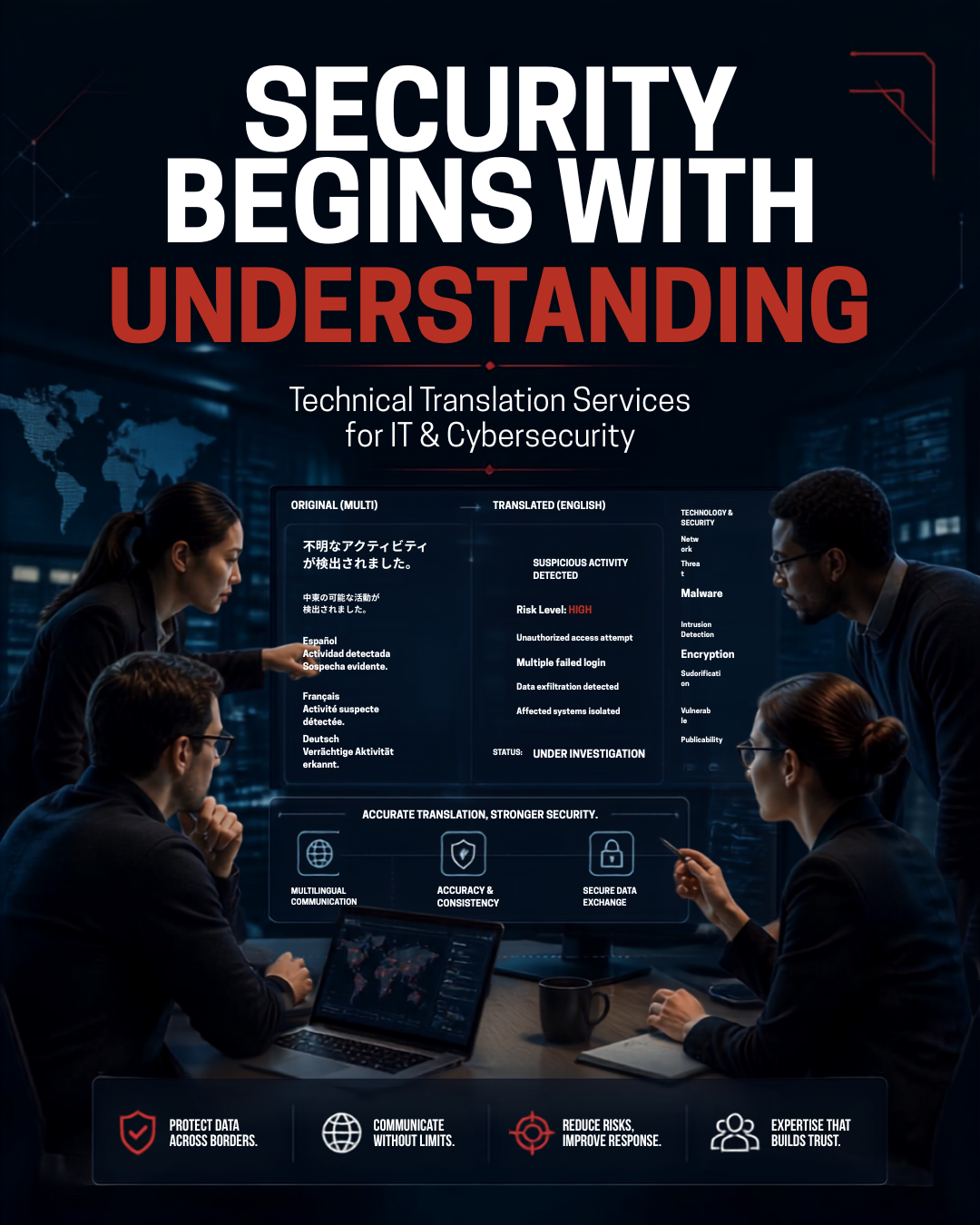
Can you protect something you don’t fully understand?
In cybersecurity, that question matters more than it first appears.
Organizations invest in firewalls, endpoint protection, identity management, threat detection and security operations. But somewhere between the technology and the person expected to use it, there is still something surprisingly powerful:
Language.
A security policy nobody understands won’t change behavior.
An incident-response procedure translated incorrectly can create confusion when every second matters.
And today, the problem is becoming more complicated.
Artificial intelligence is giving attackers new ways to create convincing messages, adapt them to their targets and operate at greater speed and scale.
That’s why, when it comes to cybersecurity, security begins with understanding.
Let’s look at why technical translation and localization are becoming part of that equation.
1. Cybersecurity Has Its Own Language
Cybersecurity isn’t simply filled with complicated words. Many of those words have precise technical meanings.
Authentication. Authorization. Encryption. Vulnerability. Exploit. Threat actor. Zero Trust. Privilege escalation. Lateral movement.
Changing the terminology carelessly can change the meaning.
Fortinet has addressed this problem directly, arguing that cybersecurity professionals need to translate technical terminology into language that business leaders can actually understand. The company points out that executives need to understand cybersecurity terminology in order to ask better questions and make better decisions.
That principle applies beyond the boardroom.
Employees, customers, developers, security teams and technical partners all need to understand security information according to their role.
So technical translation isn’t simply:
English → another language.
It is:
technical meaning → accurate technical meaning → understood by the intended audience.
2. AI Has Changed the Threat Landscape
AI isn’t only being used by defenders.
Microsoft’s 2026 threat research found that threat actors are using generative AI to draft phishing messages, translate content, summarize stolen information, generate and debug malware, and support other stages of cyber operations.
Even more importantly for this discussion, Microsoft reported that AI-assisted phishing campaigns were achieving click-through rates as high as 54%, compared with around 12% for more traditional campaigns. The company attributed part of this improvement to AI’s ability to localize content and adapt messages to specific roles and targets.
That changes the role of language.
An attacker no longer needs to send an obviously suspicious message full of awkward grammar.
AI can help make the message sound more natural, more relevant and more appropriate to the target.
Microsoft has also documented phishing campaigns using familiar AI brands as bait, including a 2026 campaign impersonating ChatGPT and attempting to collect payment and personal information.
Attackers are using language as part of the attack.
Defenders need to take language just as seriously.

3. The Human Layer Is Still Part of the Security Layer
Should I open this attachment?
Should I approve this login?
Should I report this message?
Should I follow this incident-response procedure?
These are human decisions.
And understanding influences all of them.
This is why security awareness cannot simply be translated word-for-word. A security message has to make sense to the people receiving it.
Localization becomes particularly important here.
A warning written for a U.S. audience may need more than vocabulary changes before it makes sense to employees in the Philippines, Japan, Germany or Brazil.
Expressions, examples, tone, cultural references and even expectations around workplace communication can affect how a message is interpreted.
Translation preserves the language. Localization helps preserve the meaning in context.
4. Technical Accuracy Matters
Imagine a translated incident-response instruction where “disable” becomes something closer to “delete.”
Or where “must” becomes “should.”
Or where the same authentication mechanism receives different names across a company’s security documentation.
The sentences might still look perfectly grammatical.
They can also be operationally wrong.
That is why technical translation requires terminology management, consistency, revision and subject-matter expertise.
ISO 17100:2015 establishes requirements for the core processes and resources involved in delivering quality translation services.
The important principle is simple:
A technically correct translation has to preserve technical meaning—not merely produce grammatically correct sentences.
5. Security Also Applies to the Translation Workflow
There is another layer that is easy to overlook.
The documents being translated may themselves contain sensitive information:
- Network architecture
- Security procedures
- Vulnerability information
- Incident reports
- Product specifications
- Internal policies
- Technical documentation
- Customer or employee information
So the security question isn’t only:
“Is the translation accurate?”
It’s also:
“Who has access to the information while the translation is being produced?”
A professional technical translation operation should consider security throughout the workflow.
Files, communication, project access and information handling all form part of the environment in which the translation is produced.
6. What Happens When Technical Content Becomes Multilingual?
A cybersecurity team may start with one security policy.
Then comes product documentation.
Then employee training.
Then software localization.
Then customer communications.
Then incident-response material in several languages.
Then a multilingual meeting requiring interpretation.
At that point, language is no longer an isolated translation requirement.
It has become part of the organization’s operational infrastructure.
And this is where localization becomes particularly valuable.
The goal isn’t simply to make security information available in another language.
The goal is to make sure the intended audience can understand it, act on it and interpret it correctly within their own context.
Where Etranslation Makes a Difference
When the content is technical, the language service needs to be more than a translation step added at the end of a project.
It needs to be planned from the beginning.
That means understanding the subject matter, identifying the expertise required, selecting appropriately qualified linguists, maintaining terminology and managing the workflow securely.
This is the approach behind Etranslation.
Our ISO-certified translation and interpreting services are supported by a structured process for screening linguists according to the requirements of each assignment—not simply by language pair, but by the expertise the content demands.
Behind the service is TranslatorsHub, our working platform for managing translation, localization, subtitling and online interpretation. Organizations submit their requirements through TH, receive updates as projects progress, and work through a structured environment designed to keep communication, project management and sensitive information controlled.
And because technical requirements rarely stay limited to one document, the same operation can support organizations as their multilingual needs expand across translation, localization and interpretation.
The objective isn’t simply to translate technical content.
It’s to make sure the meaning survives the journey—from the people who created the technology to the people who need to understand, use or secure it.
The Bottom Line
Cybersecurity is often described in terms of technology.
Firewalls. Encryption. Zero Trust. Identity. Detection. Response.
But underneath all of it is a human requirement:
People need to understand what the security system, policy or warning is asking them to do.
And AI is making that requirement even more important.
If attackers can use AI to create localized, convincing messages at scale, organizations cannot afford to treat multilingual security communication as an afterthought.
Accurate traduction helps preserve technical meaning.
Effective localization makes that meaning relevant to the people receiving it.
And professional language operations help ensure that sensitive technical information is handled with the appropriate expertise and controls.
Because in cybersecurity:
If people don’t understand the message, they may not understand the risk.
And if they don’t understand the risk, even the best security technology can be harder to use effectively.
Need technical translation or localization for IT and cybersecurity?
Tell us what you’re working with, which languages you need and what technical expertise the project requires.
We’ll help determine the appropriate language solution and handle the planning behind it.

 French
  English
Aucune réponse