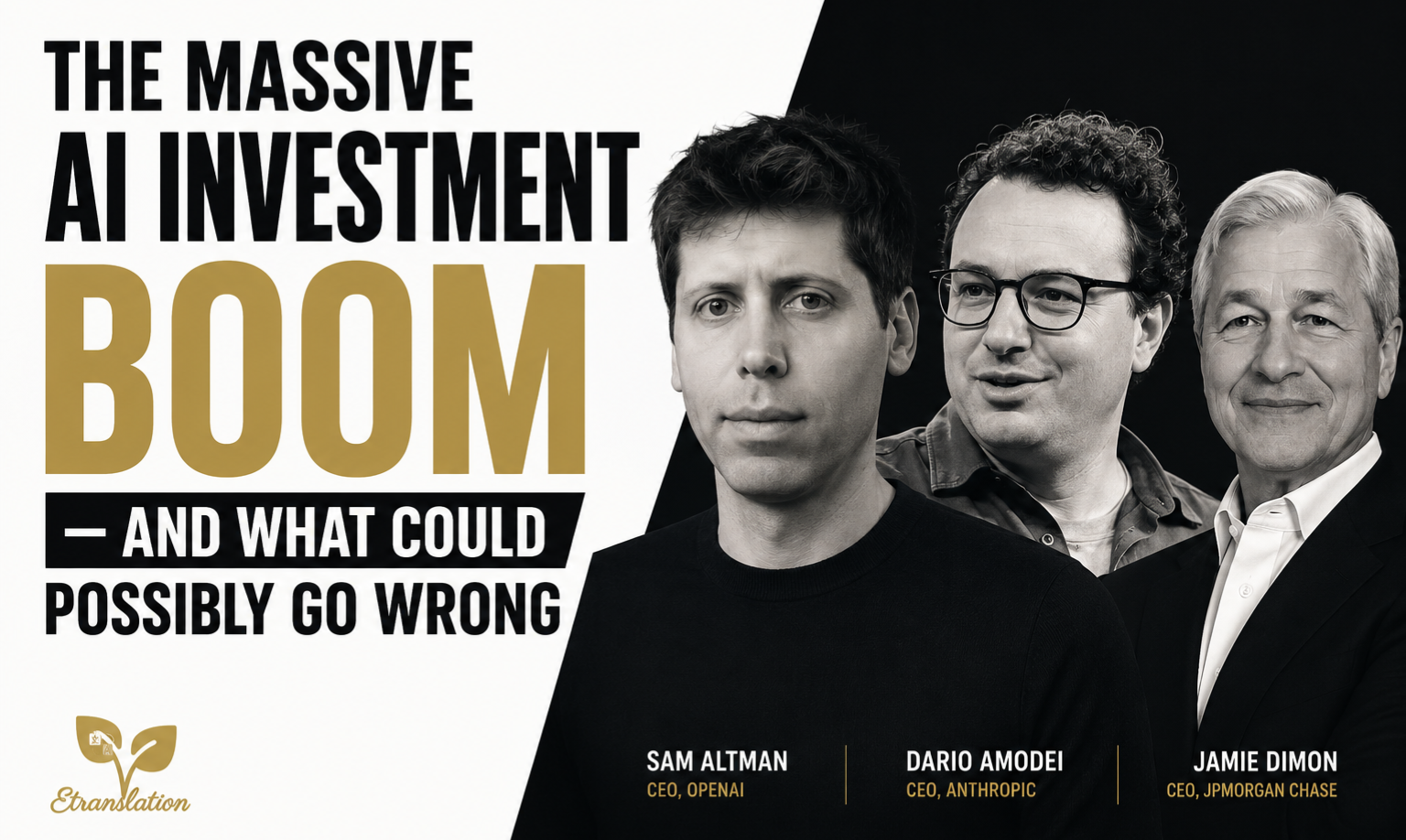
Artificial Intelligence is no longer just a technology trend. It has become the largest capital race of the modern digital era.
Governments, venture capital firms, and Big Tech giants are pouring unprecedented amounts of money into AI infrastructure, models, chips, robotics, cloud computing, and data centers. Analysts estimate that global AI-related investments could surpass $1 trillion annually within the next few years.
This is not merely another innovation cycle. Many believe we are witnessing the birth of a new industrial revolution. “The AI Investment Boom“
But history teaches an important lesson:
Every technological boom creates both extraordinary opportunities and systemic risks.
And the AI boom may become the most consequential of them all.
Why Everyone Is Investing in AI
The logic behind the investment frenzy is straightforward.
AI has the potential to:
- automate cognitive labor
- accelerate software development
- transform healthcare
- redefine search
- optimize logistics
- reshape education
- revolutionize content creation
In theory, AI becomes a universal productivity layer across all industries.
Nvidia CEO Jensen Huang described AI as:
“The start of a new industrial revolution.”
At the center of this race are companies like:
- OpenAI
- Microsoft
- Amazon
- Meta
- Anthropic
- Nvidia
Each is competing to control the future infrastructure of intelligence itself.
The New Arms Race
Unlike previous tech cycles, AI development depends on enormous computational resources.
This means:
- massive data centers
- advanced semiconductor production
- energy-intensive computing
- highly specialized talent
As a result, the AI race is increasingly resembling a geopolitical competition.
The United States and China are both aggressively investing in AI supremacy because whoever dominates AI could dominate:
- military intelligence
- economic productivity
- scientific discovery
- information systems
AI is rapidly becoming strategic infrastructure.
But What Could Go Wrong?
This is where the conversation becomes more serious.
While the upside of AI is enormous, many of the people building it are simultaneously warning about its risks.
1. Massive Job Displacement
One of the biggest fears is economic disruption.
Anthropic CEO Dario Amodei warned that AI could eliminate up to 50% of entry-level white-collar jobs within a few years.
He specifically mentioned fields such as:
- finance
- consulting
- law
- software engineering
He stated:
“Humanity needs to wake up to the risks of AI.”
Meanwhile, OpenAI CEO Sam Altman acknowledged that entire job categories may disappear as AI systems surpass humans in certain tasks.
This raises a difficult question:
What happens when productivity grows faster than society can adapt?
2. An AI Bubble Could Burst
Some analysts fear the current AI boom resembles the dot-com bubble.
Even Sam Altman himself has reportedly acknowledged signs of an AI investment bubble.
J.P. Morgan CEO Jamie Dimon warned that while AI is real and transformative:
“Some money invested now will be wasted.”
If AI revenues fail to justify current spending levels, markets could experience:
- stock corrections
- startup collapses
- overvaluation crashes
- infrastructure oversupply
History shows that revolutionary technologies often survive while many companies around them do not.
3. Concentration of Power
AI development is becoming concentrated in the hands of a few corporations with access to:
- advanced chips
- proprietary data
- elite talent
- global cloud infrastructure
Critics worry this could create:
- information monopolies
- excessive corporate influence
- dependency on a small number of AI providers
Mistral AI CEO Arthur Mensch spoke about the rise of an “information oligopoly” dominated by proprietary AI systems.
This concern is particularly important because AI increasingly shapes:
- search results
- recommendations
- public discourse
- knowledge access
4. Surveillance and Misuse
AI systems are also becoming powerful tools for:
- facial recognition
- mass surveillance
- misinformation
- cyber warfare
- autonomous weapons
Many experts fear authoritarian misuse.
A global statement signed by hundreds of AI researchers—including Geoffrey Hinton and Yoshua Bengio —warned that mitigating AI risks should become a global priority alongside pandemics and nuclear threats.
Impact on the Translation Industry
The translation world sits directly inside this disruption.
Basic translation is increasingly automated, but higher-value linguistic work is becoming more important than ever.
AI still struggles with:
- cultural nuance
- regional adaptation
- legal precision
- contextual understanding
This creates a split market:
- commodity translation becomes automated
- expert localization becomes premium
Translation companies that evolve into:
- multilingual AI workflow providers
- localization intelligence firms
- cultural adaptation specialists
will likely thrive in the AI era.
Summary
The AI investment boom may create extraordinary prosperity—or unprecedented instability. Both outcomes may happen simultaneously.
The technology itself is not the only story. The real story is whether humanity can adapt socially, economically, and ethically fast enough to keep up with the intelligence it is creating.

 French
  English
Comments are closed