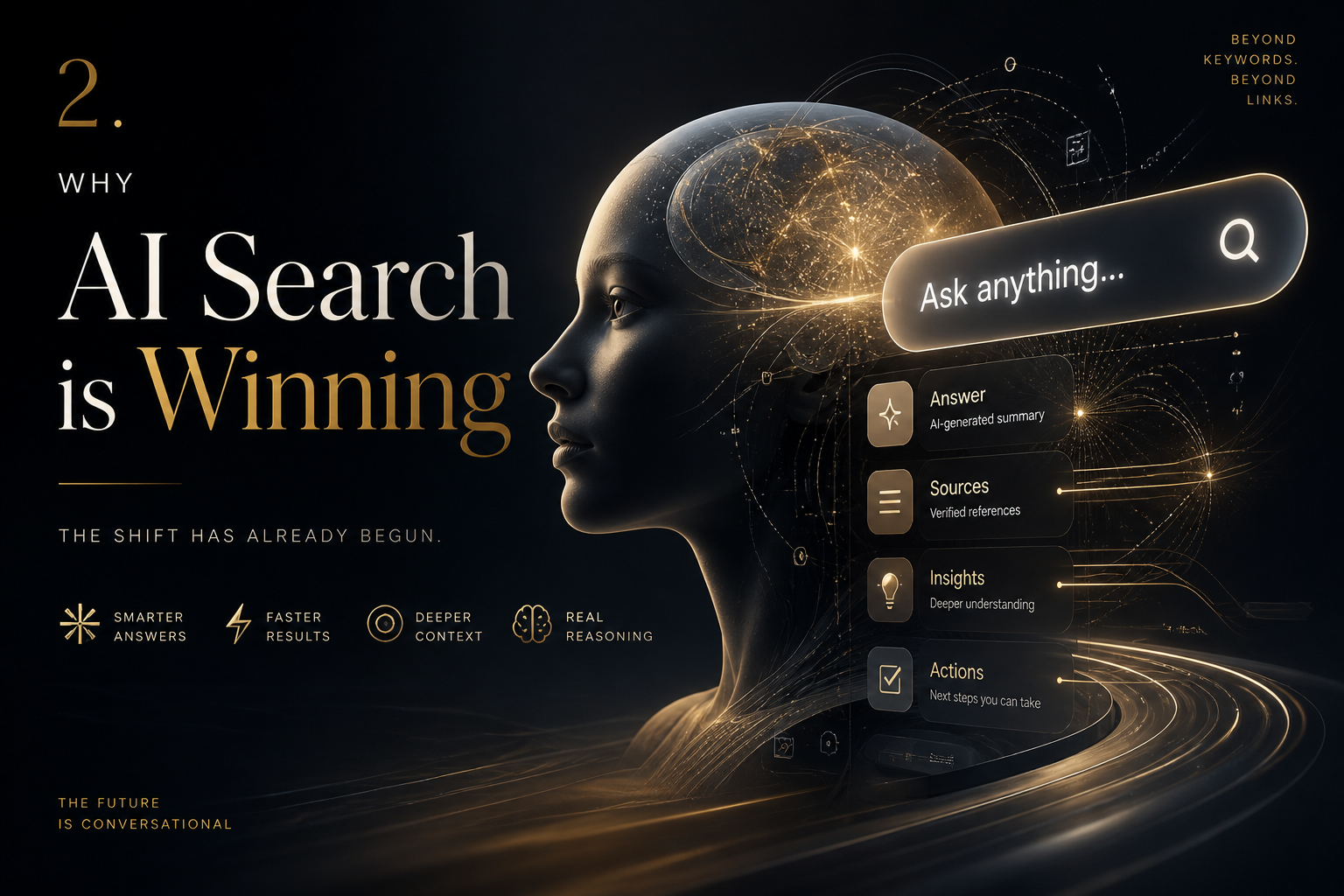
The way humans access information is undergoing a fundamental transformation. For over two decades, traditional search engines dominated the digital landscape, acting as gateways to the internet. Today, that paradigm is being disrupted. AI search is not just improving search—it is redefining it.
This shift is not incremental. It is architectural.
From Search Engines to Answer Engines
Traditional search engines operate on a retrieval model. You input keywords, and the system returns a ranked list of links. The burden is on you to sift through results, compare sources, and extract meaning.
AI search removes that friction.
Instead of presenting options, it delivers synthesized answers. It aggregates multiple sources, interprets context, and produces a coherent response in natural language. The result is a transition from searching for information to receiving outcomes.
This is why AI search is winning: it collapses multiple cognitive steps into one seamless interaction.
The Power of Context and Intent
One of the biggest limitations of traditional search is its dependence on keywords. Users had to learn how to “speak Google,” often simplifying complex needs into fragmented queries.
AI eliminates that constraint.
Users can now ask:
“What’s the best workflow for managing multilingual content across three markets with a small team?”
This is not just a query—it’s a problem. AI understands intent, constraints, and context simultaneously. It doesn’t just return links; it proposes solutions.
This capability fundamentally changes user expectations. Search is no longer about exploration—it’s about resolution.
Multi-Step Reasoning and Personalization
AI search systems are designed to handle layered thinking. They can compare options, apply filters, and adapt responses based on follow-up questions.
For example:
- “Compare three tools under $50/month”
- “Now include ones that support French and Arabic”
- “Which one is easiest for non-technical teams?”
This iterative refinement mirrors how humans think. Traditional search struggles here because it treats each query as isolated. AI treats them as part of a continuous conversation.
The Decline of Traditional SEO
This evolution has significant consequences for the digital ecosystem.
A large portion of web traffic has historically come from informational queries—“what is,” “how to,” and similar content. AI now answers these directly, reducing the need to click through to websites.
This leads to:
- Fewer clicks for generic content
- Higher competition for visibility
- A shift toward authoritative, high-value information
SEO is not disappearing, but it is evolving. The new objective is not just to rank—it is to be referenced by AI systems. Content must be structured, credible, and genuinely insightful to be included in synthesized answers.
Impact on the Translation Industry
The translation sector is particularly affected by this shift.
1. Commoditization of Basic Translation
AI tools can now instantly translate text with reasonable accuracy. For simple use cases, this reduces demand for basic translation services.
However, this is only the surface.
2. Rise of Contextual and Cultural Translation
AI still struggles with nuance:
- cultural context
- idiomatic expressions
- domain-specific language
This creates a new opportunity. Translation is moving from word conversion to meaning preservation. Businesses need experts who can ensure that messaging resonates across cultures—not just languages.
3. Integration into AI Workflows
Translation is no longer a standalone service. It is becoming embedded within broader AI-driven systems:
- multilingual customer support
- global content pipelines
- real-time localization
Companies that adapt to this integration will gain a strategic advantage.
Broader Industry Implications
The impact of AI search extends far beyond translation.
Media and Publishing
Content farms and low-quality articles are losing relevance. High-quality, original insights are becoming the currency of visibility.
E-commerce
Product discovery is shifting from browsing to recommendation. Instead of searching for products, users ask AI what to buy—and why.
SaaS and B2B
Decision-making is increasingly influenced by AI-generated comparisons and summaries. Being included in these outputs is now critical for growth.
Education and Knowledge Work
Learning is becoming conversational. Instead of searching for resources, users engage in dialogue, accelerating comprehension and reducing friction.
A New Information Economy
At its core, this shift represents a change in how value is created and distributed.
- Information is abundant
- Attention is scarce
- Trust is selective
AI acts as a filter, compressing vast amounts of data into actionable insights. This makes it the new gatekeeper of knowledge.
Conclusion
AI search is winning because it aligns with human behavior. It reduces effort, understands intent, and delivers outcomes.
But it also raises the bar.
For industries like translation, the future belongs to those who move beyond execution and into expertise—those who provide depth, context, and meaning in a world increasingly driven by automation.
The question is no longer:
“How do we rank in search?”
It is:
“How do we remain relevant when answers replace searches?”
Those who answer that question correctly will define the next era of digital interaction.
Arthur William Eyango

 French
  English
Comments are closed