A certified translation comes with a signed statement saying it’s complete and accurate. That’s different from notarization, where a notary confirms who signed, and from an apostille, which authenticates where a public document came from. Rules vary by receiving office, so check what yours wants first.
Anyone hunting for certified translation services Philippines offices and foreign authorities will accept usually has a deadline, a checklist and a real fear of getting rejected. Etranslation translates official documents like PSA certificates, NBI clearances and diplomas, plus contracts, and where certification is needed we can supply a statement of accuracy with the translation. Here’s what “certified” actually means, how it differs from notarization and apostille, and what to get ready before you start.
What “certified translation” means
Put simply, a certified translation is a translation with a signed statement attached, saying it’s complete and accurate. That statement normally carries the translator’s qualifications, a confirmation of accuracy and completeness, the document and language details, and the signer’s name along with a signature and a date. The American Translators Association explains this format. It also points out that in the United States anyone can certify a translation, and that translation companies can certify work done by their linguists, which is a big part of why the format varies so much.
Why there is no single definition
There’s no single worldwide definition. Each receiving office decides for itself what it accepts, which is why the same certificate can pass at one desk and get sent back at another. One university might want a signed statement on company letterhead, a consulate might ask for a notarized signature, and a court could want something else again.
What the Etranslation certificate covers
Etranslation provides a certificate of accuracy, signed by Arthur William Eyango, our CEO and a Registered Translator and Interpreter. It says the translation is complete and faithful to the document you gave us, and that’s all it vouches for: it doesn’t speak for any office’s rules, and it doesn’t stand in for a notary or an apostille, which come from other people entirely.
Certified, notarized and apostilled: the differences
People mix these three terms up all the time. It’s the most common reason paperwork gets bounced.
| Term | What it does | Who provides it | When it is usually asked for |
| Certified translation | Confirms the translation is complete and accurate | Translator or translation company | Visa, immigration, school, employment and legal submissions |
| Notarization | A notary confirms the identity of the person who signed the certificate; it does not check the translation itself | Notary public | When the receiving office asks for a notarized certificate |
| Apostille | Authenticates the origin of a public document (signature, seal and capacity of the issuer); it does not certify the content | Philippine Department of Foreign Affairs for documents issued in the Philippines | Using a Philippine public document in another country that is party to the Apostille Convention |
The Department of Foreign Affairs says an apostille only certifies where a public document came from, not what’s written in it, and its apostille FAQ also covers which documents qualify and what applies to countries outside the convention. Rules change. Look at the DFA page and ask the receiving office before you order anything.
Documents people most often need certified
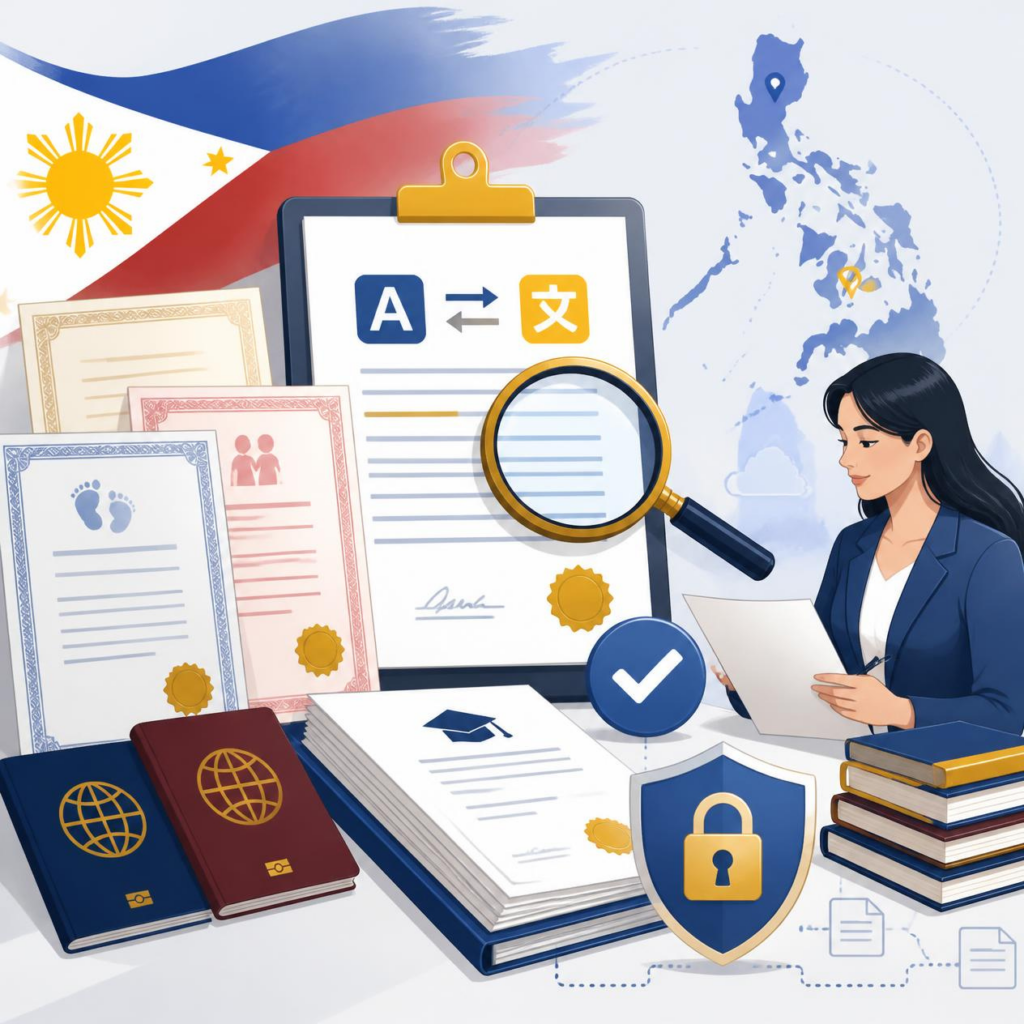
Most requests involve civil, academic or legal records, and a typical batch looks something like this:
- PSA civil registry documents, meaning birth, marriage or death certificates, which come from the Philippine Statistics Authority.
- NBI clearances and police clearances for visas or jobs abroad.
- Diplomas, school certificates and transcripts, usually for study or professional registration.
- Contracts, powers of attorney and corporate paperwork.
- Bank statements, employment certificates, tax records: anything an immigration or financial application asks for.
Tagalog documents are straightforward for our Filipino linguists. Handwriting, stamps or notes in the margin? We translate those too, and if something is unreadable we describe it instead of guessing.
How the process works
- Ask the receiving office what it wants: certification, notarization, apostille, wording, format, original or copy.
- Send clean scans or photos of the full document. Both sides. Every stamp. Any attachments.
- We look over the files, count the words, check fuzzy matches and repetitions, and send a clear quotation in under an hour. Then we confirm the scope and the languages, and tell you what the certificate will say before any translating starts.
- A linguist translates the document, keeping the layout lined up with the original and every name, date and number matching it.
- A proofreader compares the source and the translation for omissions, misspellings and anything ambiguous.
- The certificate of accuracy is signed and attached to the translation. You get it as a PDF, a hard copy, or both. It carries a QR code, so you can download your certificate again whenever you need it from our TranslatorsHub page.
- Need notarization or an apostille as well? You arrange those with the relevant provider, using the finished translation.
What to prepare before you send documents
A few checks can save you days. Run through this list before you ask for a quote.
- Exact name of the office, embassy or school receiving the translation.
- Its written requirements for certified translations, if it publishes any.
- Full colour scans with no cropped edges, and every page in the right order.
- Names spelled the way they appear in your passport, because mismatches cause rejections.
- Which language the translation must be in, and which regional style of it.
- Your deadline for the finished set. Add any apostille or notary time on top of that.
Official documents are usually quoted per page or per document, since many are short and follow a fixed layout, and our price guide shows how those quotes get built.
Why accuracy matters more than speed
Small slips cost a lot in official files. One misspelled surname, a wrong date format or a missing stamp description can make an immigration officer or registrar doubt the whole submission. That’s why names and numbers, along with dates, get an extra look in our process, and why ambiguous entries are flagged rather than quietly resolved. Nobody wants to find that out at the counter.
Official documents rarely travel alone. If you’re translating a full set, our document translation service handles the formatting, file types and consistency between documents. Records tied to healthcare are a separate case, so see our medical translation guidance for those.
Why choose Etranslation
- Filipino linguists based in the Philippines, who read local documents and names every day, and know the formats.
- Experience with healthcare and education paperwork, and with NGO documents too.
- 89 languages (210 with regional variants), for documents going into or out of English or Tagalog.
- Straight talk about what you need, including what a translator can’t do, like apostille or notarization.
To get a quote, send your scans through the quote form and tell us who will receive the translation. Part of a bigger project? our main translation services overview covers that.
Frequently asked questions
What is a certified translation?
It’s a translation delivered with a signed statement that it’s complete and accurate. The statement usually names the translator, the document, the languages, the date and the signature. Acceptance rules vary. Find out what wording and format the receiving office wants before you order, since it’s far cheaper to ask now than to redo the work later.
Is a certified translation the same as a notarized translation?
No. Certification means a statement of accuracy is included. With notarization, a notary public confirms the identity of whoever signed that statement, and doesn’t check the translation itself. Some offices want both, others just one. Confirm which before you pay for anything.
Do I need an apostille for my translated document?
Not always. An apostille authenticates the origin of a Philippine public document so it can be used in another convention country. It says nothing about the content. Check the Department of Foreign Affairs site and the receiving office, then arrange the apostille separately from the translation.
Can you translate a PSA birth certificate?
Yes. We translate PSA civil registry documents such as birth or marriage certificates, and death certificates as well. Send a clear scan of the full document, including any stamps and annotations. Tell us the receiving country and the purpose so we can plan the output, and let us know how names should be spelled.
Will immigration or a university accept your certified translation?
That’s the receiving office’s call, not ours. We can prepare the translation and certificate to the requirements you give us. Ask the office for its written rules and send them along with your files. We’ll follow them where we can.
How long does certified translation take?
It depends on page count, language, the condition of the document and any extra steps like notarization or apostille. Short civil documents go faster than long contracts. Give us your deadline when you request a quote, and before work begins we’ll tell you what schedule is realistic.
No responses yet