For years, autonomous driving in Cars has been presented as a question of “when,” not “if.”
But getting a car to drive itself is proving to be far more complicated than teaching it how to stay between two lines.
Today, Waymo, Tesla, Baidu, Zoox, Wayve and several other companies are competing to solve one of the biggest technological challenges of our time:
How do you make a machine safely understand and navigate the real world?
And interestingly, this race didn’t begin with today’s AI boom.
The technology behind autonomous perception has been developing for decades. In the late 1980s, researchers were already training neural networks to make vehicles follow roads. Later projects focused on recognizing cars, pedestrians, traffic signs, lanes and drivable surfaces—many of the same problems today’s autonomous vehicles still have to solve.
So, where are we now?
Let’s look at some of the key battles that could determine who wins the race to autonomous driving.
1. The First Battle: How Does a Car See the World?
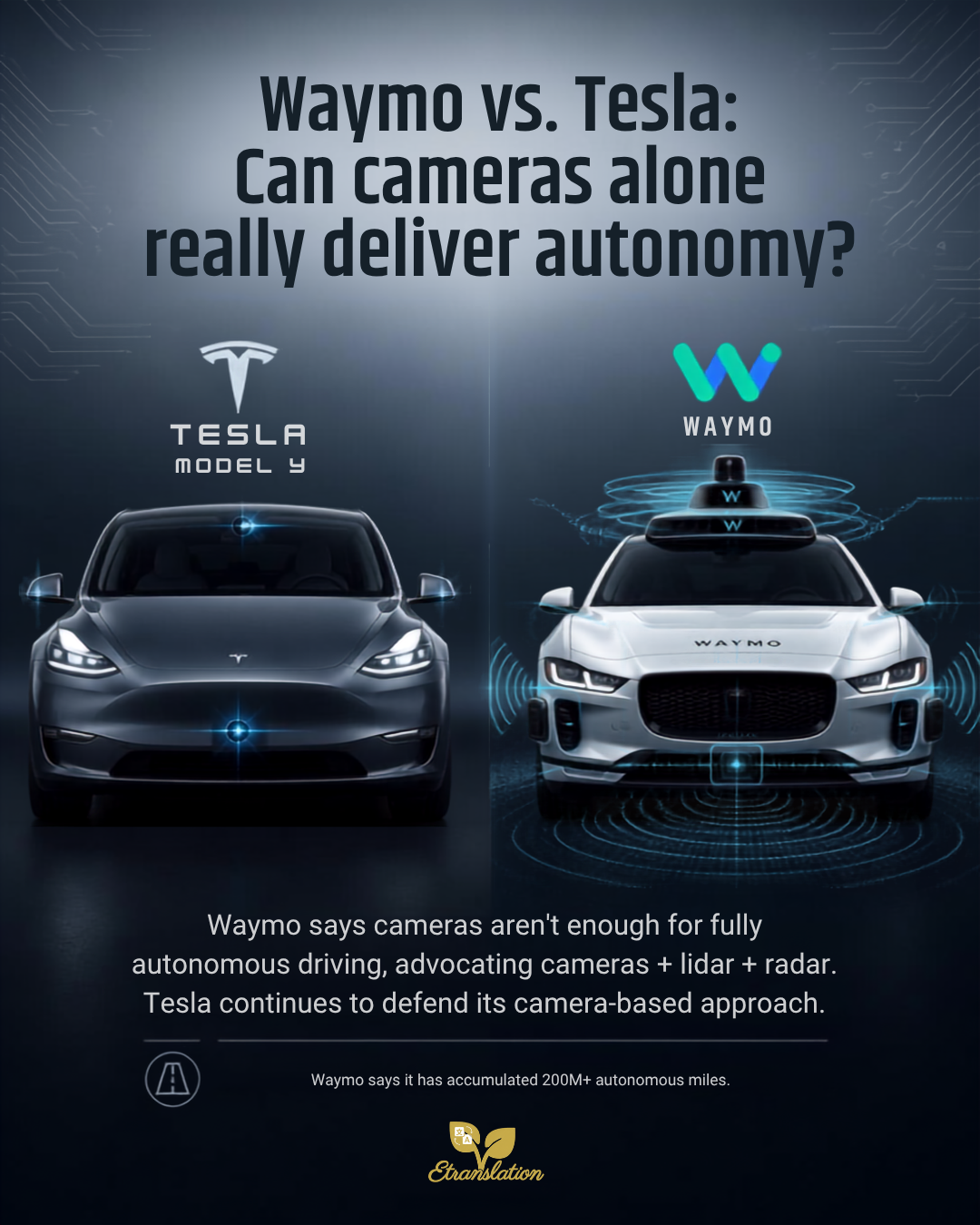
This is where the famous Waymo vs. Tesla debate comes in.
Waymo has now accumulated more than 200 million miles of fully autonomous driving and argues that safe autonomy at scale requires multiple sensing systems working together: cameras, lidar and radar.
Tesla has taken a fundamentally different approach, relying heavily on cameras and neural networks to interpret the environment. Tesla describes its system as using computer vision for tasks such as object detection, semantic segmentation, depth estimation and road-layout understanding.
But this isn’t really a debate about whether cameras are useful.
They clearly are.
The bigger question is:
How much information does an autonomous vehicle need before it can make a decision safely?
A 2018 review of autonomous-vehicle perception research identified challenges including weather and lighting conditions, detection certainty, sensor faults and algorithm efficiency.
In other words, the problem isn’t simply teaching a car to see.
It’s teaching it to see reliably when the world becomes difficult.
2. The Second Battle: Data
This is where autonomous driving starts to look much more like modern AI.
A vehicle doesn’t just need to recognize a pedestrian.
It needs to understand what that pedestrian is likely to do next.
It needs to distinguish between a plastic bag blowing across the road and an object that could actually be dangerous.
It needs to understand thousands of unusual situations that engineers could never manually program one by one.
This is why data has become one of the industry’s most important assets.
Tesla says its neural networks learn from complicated and diverse scenarios gathered from a fleet of millions of vehicles, while Waymo has accumulated more than 200 million fully autonomous miles in real-world operations.
But there is an important distinction:
More data doesn’t automatically mean better AI.
The quality, diversity and difficulty of the scenarios matter.
The real advantage may belong to whoever can collect and learn from the situations that break the system, rather than simply the situations it already handles well.

3. The Third Battle: Can AI Handle the Unexpected?
This may be the hardest part.
Driving is full of situations that aren’t written in a rulebook.
A road suddenly closes.
A police officer directs traffic differently from the traffic lights.
A cyclist moves unpredictably.
Construction changes the road overnight.
A pedestrian makes a decision that nobody expected.
This is where autonomous driving becomes much more than a computer-vision problem.
The vehicle needs to perceive, predict, reason and act—sometimes within milliseconds.
And research has repeatedly identified perception, scene understanding and decision-making under uncertainty as fundamental challenges for autonomous vehicles.
The lesson from decades of research is surprisingly simple:
The real world doesn’t follow a script.
4. The Fourth Battle: Compute
There is another part of autonomous driving that we rarely see because it happens inside the vehicle.
The computer.
An autonomous vehicle is effectively running a very demanding AI system while moving through the physical world.
Waymo recently revealed that its computing platform has increased its processing capability 20-fold over eight years, while its latest system uses custom silicon to process camera, lidar and radar data in real time.
Tesla has also developed custom AI inference hardware specifically for its vehicles and trains neural networks for perception and control.
The challenge is not simply having a powerful computer.
It needs to be fast, reliable, energy-efficient and capable of making decisions with extremely low latency.
Because when your AI is driving at highway speed, a delay isn’t just a loading screen.
5. The Fifth Battle: Safety, Regulation and Trust
Even if the technology works, another question remains:
When do we allow it to operate without a human?
Waymo is already operating fully autonomous services in multiple locations, while Tesla’s current Full Self-Driving system remains a supervised driver-assistance system requiring the driver to remain attentive.
And the regulatory race is happening alongside the technological one.
According to them, Waymo is preparing to begin testing in Munich, with plans for a commercial robotaxi service in Germany by the end of 2027. Meanwhile, the rollout of fully autonomous robotaxis in London has faced regulatory delays. Find more details here.
This shows something important:
Building the technology is only half the race.
Companies also need governments, insurers, cities and passengers to trust it.
And eventually, someone will have to answer the uncomfortable question:
If an autonomous vehicle makes a mistake, who is responsible?

Conclusion
The race to autonomous driving isn’t simply a race between Waymo and Tesla.
It is a competition involving computer vision, sensors, AI, data, computing power, robotics, regulation, infrastructure and economics.
And the fascinating part is that many of the foundations were being developed decades ago—long before today’s AI systems became powerful enough to make autonomous driving feel close to reality.
We have spent decades teaching machines to recognize lanes, vehicles, pedestrians, signs and roads.
Now we’re asking them to understand something much harder:
the unpredictable world in which all of those things exist.
The company that solves that problem first—and can prove that its solution is safe, scalable and economically viable—could fundamentally change how we move around our cities.
The question is no longer:
“Will cars drive themselves?”
It’s:
“Who will be the first to make us trust them?”
And while the automotive industry is still racing toward truly autonomous AI, another industry has already begun making the leap from chatbots that answer questions to AI systems that can reason, decide and act—discover how in this article.

 English
  French
No responses yet