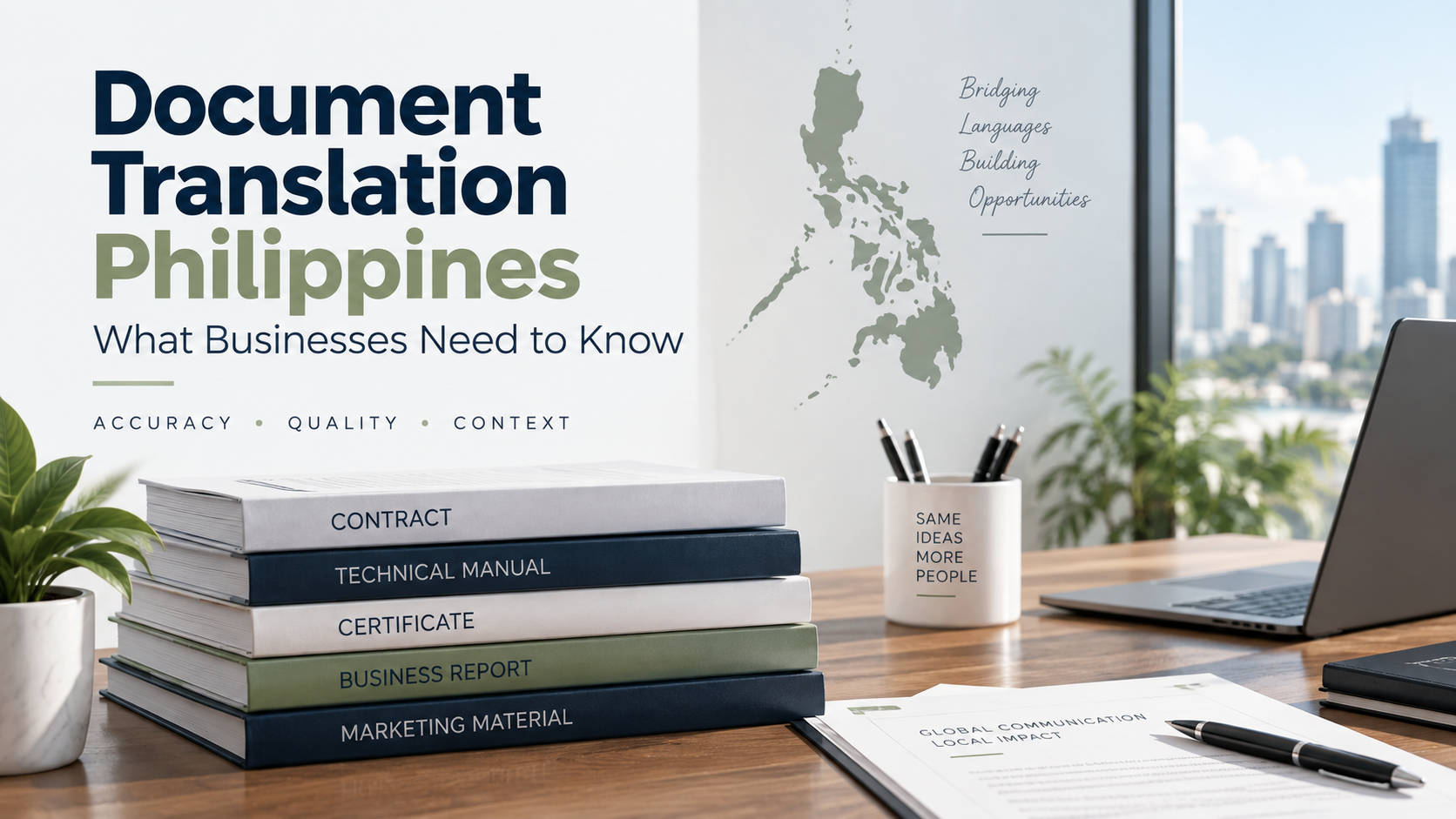
Documents are still one of the most common reasons organizations need professional translation.
Businesses operating in the Philippines may work with contracts, certificates, manuals, reports, corporate documents, academic records, marketing materials and technical files that need to be understood in another language.
But document translation is not simply about converting text.
The translator must preserve meaning, terminology, structure and, where required, the functional purpose of the original document.
What is document translation?
Document translation is the professional translation of written files from one language into another.
Common document types include:
• Business contracts
• Certificates
• Legal documents
• Technical manuals
• Financial reports
• Medical documents
• Academic documents
• Corporate policies
• Training materials
• Marketing documents
• Product documentation
Different document types require different levels of expertise.
A legal agreement requires terminology and legal context. A medical document requires appropriate medical terminology. A technical manual must prioritize precision and consistency.
Why is document translation important in the Philippines?
The Philippines has significant linguistic diversity.
The Philippine Statistics Authority reported from the 2020 Census that Tagalog was generally spoken at home in 10,522,507 households, representing 39.9% of households. Bisaya/Binisaya, Hiligaynon/Ilonggo, Ilocano and Cebuano were among the other leading languages reported.
The country’s official language framework also recognizes Filipino and English for communication and instruction, while regional languages serve as auxiliary official languages in their respective regions.
For organizations, this means language requirements can vary considerably depending on audience, location and purpose.
What makes document translation different?
Documents contain more than words.
They can contain tables, headings, signatures, footnotes, charts, references, technical terminology and formatting requirements.
A good translation therefore needs to preserve the information architecture of the original document.
This is particularly important when the document will be used operationally or professionally.
What affects document translation cost?
There is no single document translation rate that applies to every project.
Pricing can depend on:
• Word count
• Language pair
• Subject matter
• File format
• Complexity
• Formatting requirements
• Turnaround time
• Review requirements
• Certification or other special requirements
For this reason, businesses should provide the actual document when requesting a quotation rather than relying only on page count.
How do you choose a professional provider?
Look for demonstrated experience with the type of document you need translated.
A provider handling cybersecurity documentation should understand technical terminology. A provider handling medical content should have appropriate linguistic and subject matter expertise.
Quality processes also matter.
ISO 17100:2015 defines requirements for core translation processes, resources and other aspects involved in providing quality translation services.
Businesses can explore Etranslation’s professional translation services when they need document translation alongside broader multilingual support.
When document translation becomes localization
Some documents need more than direct translation.
Marketing brochures, product guides and customer communications may need adaptation for a particular market.
That is where localization becomes important.
Etranslation’s localization services focus on adapting content for local cultures, preferences and behaviors rather than simply replacing words.
Conclusion
Professional document translation in the Philippines requires more than linguistic conversion.
The language pair, document type, subject matter, formatting, deadline and intended use all influence the process.
Organizations should therefore choose a provider based on expertise, quality control, confidentiality and the ability to manage the complete project.
For businesses with recurring multilingual content, a professional language partner can also help maintain terminology and consistency across documents and other communication channels.
Tell us more about your project or send the documents directly to us here!
Comments are closed