“Chinese translation” sounds like one straightforward service.
It is not.
Businesses considering Chinese translation need to think about language variety, writing systems, audience, market, terminology and localization.
A translation intended for mainland China may require different conventions from content intended for Taiwan or other Chinese speaking markets.
That is why choosing the correct Chinese language variant should happen before the translation begins.
1. What do Chinese translation services cover?
Chinese translation services can support many types of content, including:
Business documents
Websites
Software
Technical documentation
Contracts
Marketing materials
Financial documents
Product information
Educational content
Customer support materials
Multimedia content
The appropriate approach depends on the purpose and destination of the content.
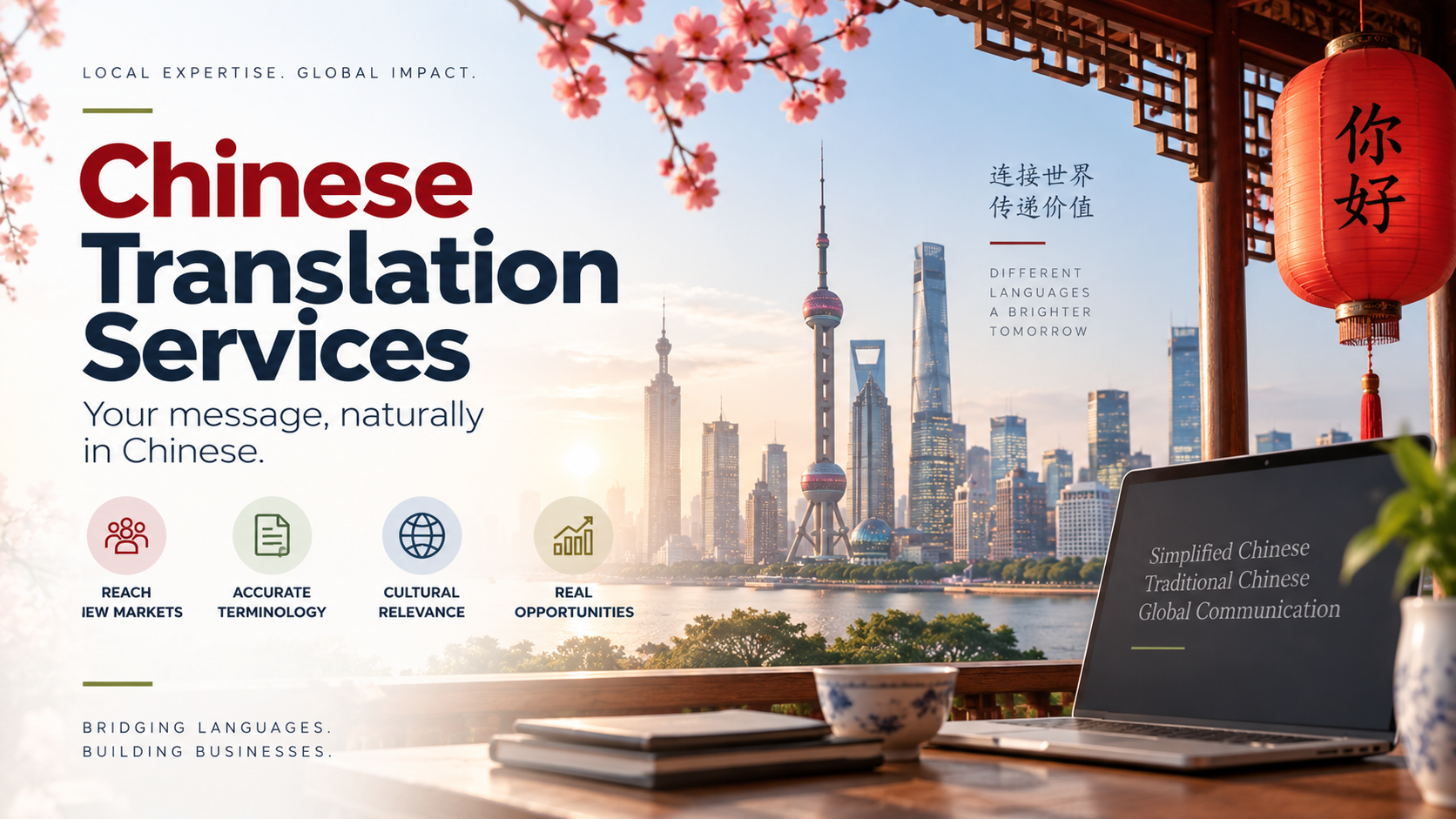
2. Simplified Chinese and Traditional Chinese
One of the first questions a business should answer is:
Which Chinese audience are we targeting?
Simplified Chinese is commonly associated with mainland China and Singapore.
Traditional Chinese is used in markets including Taiwan and Hong Kong, although language conventions can differ between markets as well.
This means selecting “Chinese” as a target language without specifying the intended market may not provide enough information for a professional project.
3. Mandarin is not the whole story
China’s national standard spoken language is Putonghua, commonly known as Mandarin, while standardized Chinese characters are the standard written form under China’s language framework. China’s revised Law on the Standard Spoken and Written Chinese Language took effect on January 1, 2026.
For businesses, however, the practical translation question is usually more specific:
Which market?
Which audience?
Which written standard?
Which industry?
Which communication style?
Those decisions affect the final result.
4. Why industry expertise matters
A financial translation requires financial terminology.
A medical translation requires medical knowledge.
An automotive document requires automotive terminology.
A software product requires technical understanding.
A translator who knows Chinese but does not understand the subject matter may produce linguistically acceptable content that is still inappropriate for the intended industry.
Professional translation therefore combines language ability with subject expertise.
5. Chinese localization goes beyond translation
Localization becomes particularly important for websites, software, ecommerce platforms, advertising and consumer products.
A sentence that works perfectly in English may require restructuring in Chinese.
A marketing slogan may need to be adapted rather than translated literally.
A user interface may need changes in layout because translated text behaves differently.
A product name may require linguistic and cultural evaluation.
The objective is not simply to make the words Chinese.
The objective is to make the experience appropriate for the target audience.
6. Terminology consistency matters
Large organizations often have hundreds or thousands of specialized terms.
If terminology changes from one document to another, customers may become confused.
Translation memories and terminology databases can help maintain consistency.
This is one reason professional translation workflows increasingly combine linguistic expertise with CAT technology.
The European Commission describes translation memory as a tool that allows translators to retrieve identical or similar passages from previous work while helping maintain consistent terminology.
7. Chinese translation and AI
AI translation has made multilingual content much more accessible.
But businesses should distinguish between content that can be processed automatically and content that requires professional review.
A low risk internal message may have different requirements from a legal contract, medical document or public marketing campaign.
For important content, human review remains essential.
8. How should you choose a Chinese translation provider?
Ask about:
Simplified and Traditional Chinese capabilities
Target market experience
Native language expertise
Industry specialization
Translation and editing processes
Terminology management
Localization capabilities
Quality assurance
Confidentiality
Project management
A provider should be able to explain not only which languages it supports, but how it manages quality.
Conclusion
Chinese translation services are not a one size fits all solution.
Businesses need to identify the intended market, language variant, audience and purpose before translation begins.
The strongest projects combine linguistic expertise, subject matter knowledge, terminology management, technology and localization.
For companies expanding into Chinese speaking markets, professional translation should be treated as part of the market entry strategy rather than an afterthought. Discover more about our Translation services here!
Looking for a trusted partner to handle your language needs ? Look no further! Send your request here!
Comments are closed