
For years, localization was largely treated as the final step in taking content global.
A company created its product, website, campaign, documentation, or marketing material in one language. Then came translation, review, formatting, and delivery for other markets.
That model is changing.
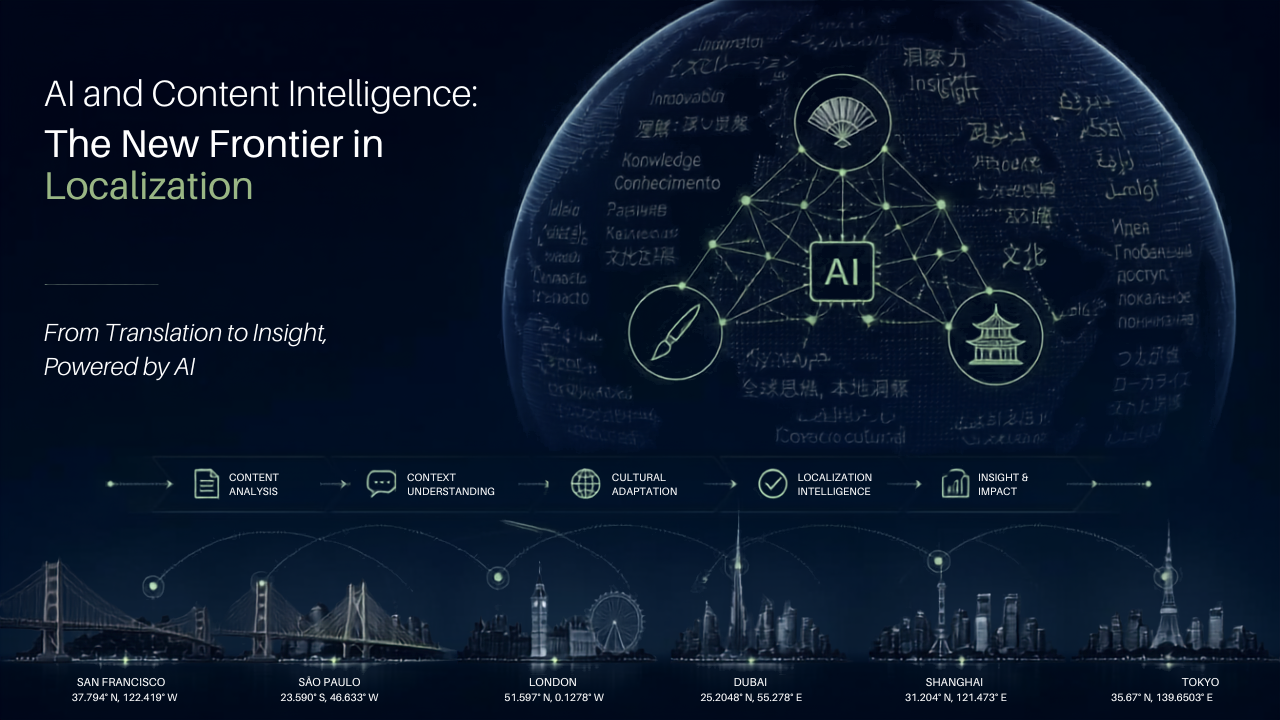
Artificial intelligence is making translation faster, but something more important is happening underneath the surface. Localization is increasingly becoming part of the broader content infrastructure of an organization, connecting translation with context, terminology, quality evaluation, SEO, cultural adaptation, automation, and market performance.
In other words, the question is no longer simply:
“How do we translate this?”
It is becoming:
“How should this content work in another market?”
That is the beginning of the shift from translation toward content intelligence.
Translation Was the Starting Point. Context Is Becoming the Differentiator.
The distinction between translation and localization has always existed.
Translation focuses primarily on transferring meaning between languages. Localization goes further by adapting content to the expectations, conventions, culture, and behavior of a particular market.
Etranslation describes localization in similar terms: adapting the broader brand experience to local cultures, preferences, and behaviors rather than simply translating words.
That distinction is becoming significantly more important as AI makes basic translation increasingly accessible.
Lokalise’s September 2026 research and product positioning provides an interesting illustration of this shift. The company describes “language market fit” as the next step beyond fluency: content adapted to a market’s audience, channel, and commercial objectives.
The implication is important.
Fluency is becoming the baseline. Context is becoming the differentiator.
A translation can be grammatically correct and still fail to communicate effectively.
A marketing campaign can preserve every sentence while losing the emotional appeal that made the original successful.
A software interface can communicate the correct meaning while using terminology that feels unnatural to local users.
Localization therefore increasingly requires understanding not only what the source says, but what the content is trying to accomplish.
AI Is Changing What a Localization Workflow Looks Like
AI translation is no longer simply a machine translation engine sitting between a source document and a human translator.
The surrounding workflow is changing as well.
Modern localization platforms are increasingly integrating AI translation, quality evaluation, content management systems, APIs, automated workflows, translation memory, terminology management, and human review.
Smartling’s September 2026 release notes, for example, document new automation capabilities for Salesforce Knowledge and Contentstack, instant translation within Figma Buzz, an MCP server capable of sending files to translation workflows, and AI translation controls designed to respect character limits.
This matters because localization is becoming increasingly embedded in the content-production process itself.
Instead of:
Create → Export → Translate → Review → Import → Publish
the emerging model looks more like:
Create → Understand context → Localize → Evaluate → Review where necessary → Publish → Measure
The difference is substantial.
Localization is moving closer to the systems where content is actually created and consumed.
The New Localization Stack Understands More Than Words
Consider a global software company launching a new product feature.
A traditional workflow might send a collection of strings to translators.
An increasingly intelligent workflow can incorporate additional information:
- What the product does
- Who the intended audience is
- Which terminology the company has approved
- How the brand communicates
- Which market is receiving the content
- Where the content will appear
- Character or layout constraints
- Whether the content is marketing, technical, legal, medical, or UI
- Whether human review is required
This is where the concept of content intelligence becomes useful.
The localization system is increasingly expected to understand the environment surrounding the words.
That does not mean AI has solved localization.
It means the localization workflow itself is becoming more contextual.
AI Translation Is Becoming Easier to Measure
One of the most important developments is the movement toward measurable AI translation quality.
For years, organizations have struggled with a basic question:
How do we know whether an AI translation is actually good enough for our content?
Lokalise recently introduced “Proof of Value,” a system that compares different translation approaches using a company’s own content and provides quantitative and qualitative comparisons. Its platform also tracks metrics such as edit distance, post-editing effort, reviewer intervention, and AI quality signals.
That is a significant change in mindset.
Instead of asking:
“Is AI translation good?”
Organizations can increasingly ask:
“Which translation workflow performs best for this content, language pair, market, and business objective?”
That is a much more useful business question.
It also reinforces an important principle: AI quality should be evaluated against real business content, not just generic benchmark scores.
More AI Does Not Mean Less Need for Human Expertise
This is perhaps the most important misconception to challenge.
AI can dramatically reduce the time and cost involved in producing multilingual content.
But faster translation does not automatically mean better localization.
Different content requires different levels of intervention.
A product string may need terminology consistency and strict character limits.
A technical manual may require subject-matter expertise.
A medical document may require highly controlled terminology and specialist review.
A marketing campaign may require cultural adaptation rather than literal translation.
A legal document may require specialist linguistic and legal review.
A subtitled video may require timing, readability, cultural adaptation, and editorial judgment.
That is why the future is unlikely to be a simple choice between AI and human translators.
The more useful question is:
Where should AI accelerate the workflow, and where should human expertise make the final decision?
The answer will vary according to content type, market, risk, and business objective.
Even Smartling’s own explanation of AI localization emphasizes a hybrid model in which AI handles volume while human linguists focus on nuance and brand-critical content.
Localization Is Becoming Connected to SEO and AI Search
Global content does not compete in a vacuum.
A company entering a new market needs its localized content to be discoverable and relevant to people searching in that market.
That makes localization increasingly connected to international SEO and, now, AI-powered search.
This is particularly interesting because it connects directly to our earlier analysis of how search is changing.
Read: Why AI Search Is Winning — And What It Means for the Future of Information.
The relationship between the two topics is becoming clearer.
AI search systems increasingly operate through context and intent rather than simply matching keywords.
Lokalise’s September 2026 research makes a related argument from the localization side: content that is adapted to the language and market of the audience can have implications for visibility in AI answer engines.
For global companies, this creates a new requirement.
It is no longer enough to ask:
“Is our website translated?”
The better question is:
“Can people in this market discover, understand, and trust our content?”
That is a localization problem, an SEO problem, and increasingly an AI-search problem at the same time.
Localization Is Becoming Part of the Content Stack
Another major shift is the integration of localization into the systems businesses already use.
Smartling’s current platform updates provide a useful example. Its September releases include automated translation workflows connected to Salesforce Knowledge and Contentstack, Figma integration, AI-agent connectivity through MCP, and controls for maintaining string-length requirements.
This illustrates where the industry is heading.
Localization is becoming less of an isolated service and more of an operational layer.
The same principle can be seen across other areas of Etranslation’s work, from translation services to localization services and multilingual content workflows.
For businesses operating across multiple markets, this means localization needs to be considered much earlier in the content lifecycle.
The Investment Market Is Paying Attention
The shift is also visible at the investment level.
On September 15, 2026, Smartling announced that Vitruvian Partners had acquired the company from Battery Ventures. Smartling said the investment would accelerate its AI translation platform, agentic localization capabilities, global expansion, and work around AI-powered quality and evaluation.
Smartling says more than 1,000 global brands use its platform and that the company translates billions of words annually across websites, applications, support content, and marketing experiences.
The significance extends beyond one transaction.
Capital is increasingly following the transformation of localization from a primarily transactional workflow into technology-enabled infrastructure.
That makes localization an increasingly interesting intersection of:
AI + language + content + software + data + global commerce.
What This Means for Businesses Going Global
Companies should stop thinking about localization as something that happens only after content is finished.
Instead, localization should be considered earlier in the content lifecycle.
1. Build terminology systems
Important product, technical, medical, legal, and industry terminology should be defined before content scales across languages.
2. Give AI proper context
AI systems perform differently depending on the information they receive. Brand guidelines, terminology, audience information, previous approved translations, and market context can all influence the outcome.
3. Create content-specific workflows
Marketing, legal, technical, medical, software UI, and multimedia content do not carry the same risks or require the same localization process.
4. Use human review strategically
Human linguists can increasingly focus on the areas where cultural understanding, subject-matter expertise, judgment, and brand sensitivity create the most value.
5. Measure outcomes, not only volume
Words translated and turnaround time are useful operational metrics.
But organizations should also consider:
- post-editing effort
- terminology consistency
- quality
- market engagement
- search visibility
- conversion
- user experience
- content performance
6. Connect localization to the content ecosystem
Localization works best when it is connected to the systems where content actually lives.
That includes CMS platforms, product development environments, marketing systems, knowledge bases, support systems, and increasingly AI agents.
The Future of Localization Is Not Translation Without Humans
It is tempting to describe the future of localization as fully automated translation.
That description misses the larger transformation.
The real opportunity is to build systems that understand:
Content + Context + Audience + Market + Terminology + Business Objective
AI is making translation faster.
Automation is making localization more connected.
Data is making quality more measurable.
But cultural intelligence, domain expertise, and human judgment remain important precisely because localization is about more than words.
Our previous article, Translation Services in 2026: What Actually Drives ROI, explored why organizations should evaluate language services based on business outcomes rather than simply translation cost. The same principle applies here.
As AI reduces the cost of producing multilingual content, the strategic question becomes even more important:
What does that content actually achieve in the market?
The companies that answer that question well will not necessarily be the ones that translate the most words.
They will be the ones that understand what those words need to accomplish.
Localization is becoming content intelligence.
And that changes the role of everyone involved in taking a business global.
Sources and further reading
- Lokalise: Entering a Market Isn’t the Same as Belonging — September 15, 2026.
- Lokalise: Language Market Fit Whitepaper — research on AI, localization, context, governance, and market performance.
- Lokalise: Data-backed AI Translation Quality — AI translation quality evaluation.
- Lokalise: Product Changelog — AI quality evaluation and localization analytics.
- Smartling: AI Localization — overview of AI localization and human-AI workflows.
- Smartling: September 2026 Release Notes — current localization automation and AI-agent capabilities.
- Smartling: Vitruvian Partners Investment — September 15, 2026.
Comments are closed