
How Should You Evaluate a Translation Services Company?
Choosing a translation services company can look simple.
Search for a provider.
Request a quote.
Compare the prices.
Choose one.
But translation is one of those services where the cheapest quotation can become the most expensive decision.
A poor translation can create misunderstandings, damage a brand, delay a product launch or create problems in regulated industries.
So how should businesses evaluate a translation company?
1. Start with expertise, not price
The first question should be:
Can this company actually handle my content?
A provider translating a restaurant menu does not necessarily have the expertise required for a medical device manual.
A legal contract is different from a marketing campaign.
A software interface is different from a financial report.
Look for a company with experience in your specific industry and content type.
2. Ask who actually does the translation
A professional translation provider should be able to explain how translators are selected and assigned.
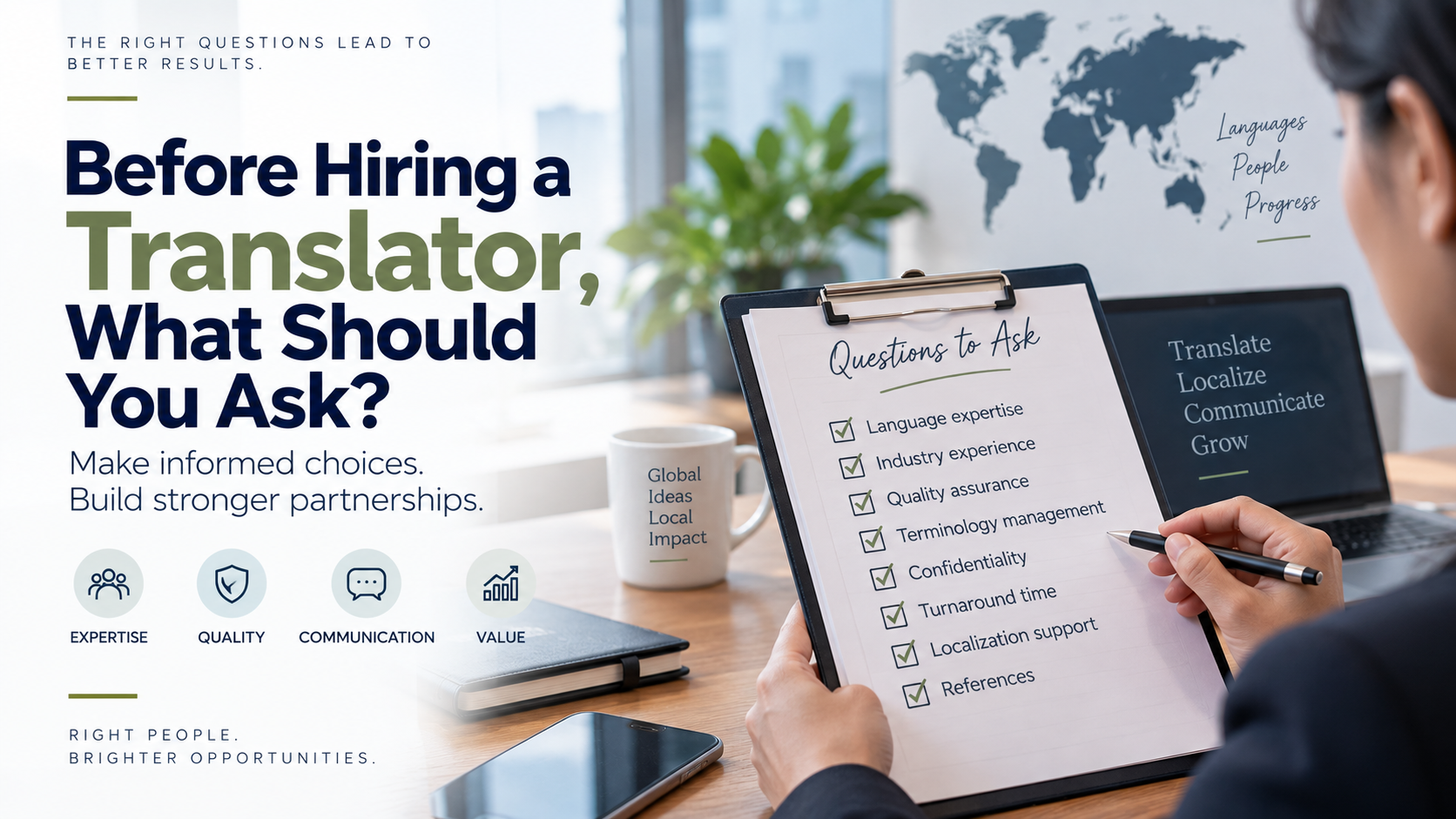
Ask about:
Language qualifications
Industry experience
Subject matter expertise
Native language capabilities
Quality review
Terminology management
Project management
For complex projects, you should know who is responsible for the linguistic quality.
3. Examine the quality process
A serious translation provider should have a defined quality process.
This may include translation, editing, proofreading, terminology checks and final quality assurance.
ISO 17100 provides requirements for the core processes and resources involved in quality translation services.
Certification is not the only thing a buyer should consider, but structured quality processes are an important indicator of maturity.
4. Ask about terminology
Terminology can make or break a specialized translation project.
Imagine a cybersecurity company using three different translations for the same technical concept across its website, product documentation and support materials.
The language may be grammatically correct.
The communication is still inconsistent.
A good provider should be able to establish and maintain terminology.
This becomes even more important for companies translating large volumes of recurring content.
5. Look at technology, but do not confuse technology with quality
Professional translation companies increasingly use CAT tools, translation memories, terminology databases and machine translation technologies.
Technology can improve efficiency.
It can help maintain consistency.
It can reduce repetitive work.
But technology does not automatically understand your brand, audience or business objective.
The European Commission, for example, uses translation memories to reuse previous translations and maintain terminology consistency across its large multilingual operation.
Technology should support the translation process, not replace the need for professional judgment.
6. Ask about localization
If you are entering another market, translation may not be enough.
A website can be grammatically perfect and still feel foreign.
A marketing campaign can communicate the literal message while missing the cultural meaning.
A software product can be translated correctly but still provide a poor user experience.
Ask whether the company provides localization.
You can explore the difference in more detail through Etranslation’s localization services.
7. Ask about confidentiality and security
Translation projects often involve confidential information.
Contracts, product specifications, financial information, medical documents and unreleased marketing campaigns may all pass through a translation workflow.
Ask:
How are files transferred?
Who can access them?
How are files stored?
What security measures are in place?
Does the provider have relevant security policies or certifications?
This is particularly important when dealing with corporate or regulated information.
8. Do not compare quotations based only on price
Two quotations may look very different because they may represent very different scopes of work.
One provider may quote for translation only.
Another may include editing, proofreading, terminology management, project management and quality assurance.
When comparing prices, compare the deliverables.
A lower price is not necessarily a lower cost if the final material needs to be corrected or retranslated.
9. Ask for relevant examples
Do not simply ask:
“Do you translate medical documents?”
Ask:
“Have you translated medical documents similar to ours?”
The same principle applies to legal, automotive, cybersecurity, software, education and financial content.
Relevant experience is much more useful than a generic list of services.
10. Evaluate communication
Translation projects involve decisions.
Terminology questions arise.
Deadlines change.
Source files may contain inconsistencies.
A good translation provider should communicate clearly throughout the project.
You should know who manages the project and how questions are handled.
Conclusion
The best translation services company is not necessarily the largest, cheapest or fastest.
It is the provider that understands your content, your audience and your business objectives, while having the processes and resources required to deliver consistently.
Before signing a contract, evaluate expertise, quality assurance, terminology, localization, technology, security, communication and total value.
That is a much better foundation for a long term language partnership.
Looking for a trusted partner to handle your language needs ? Look no further! Send your request here!
Comments are closed