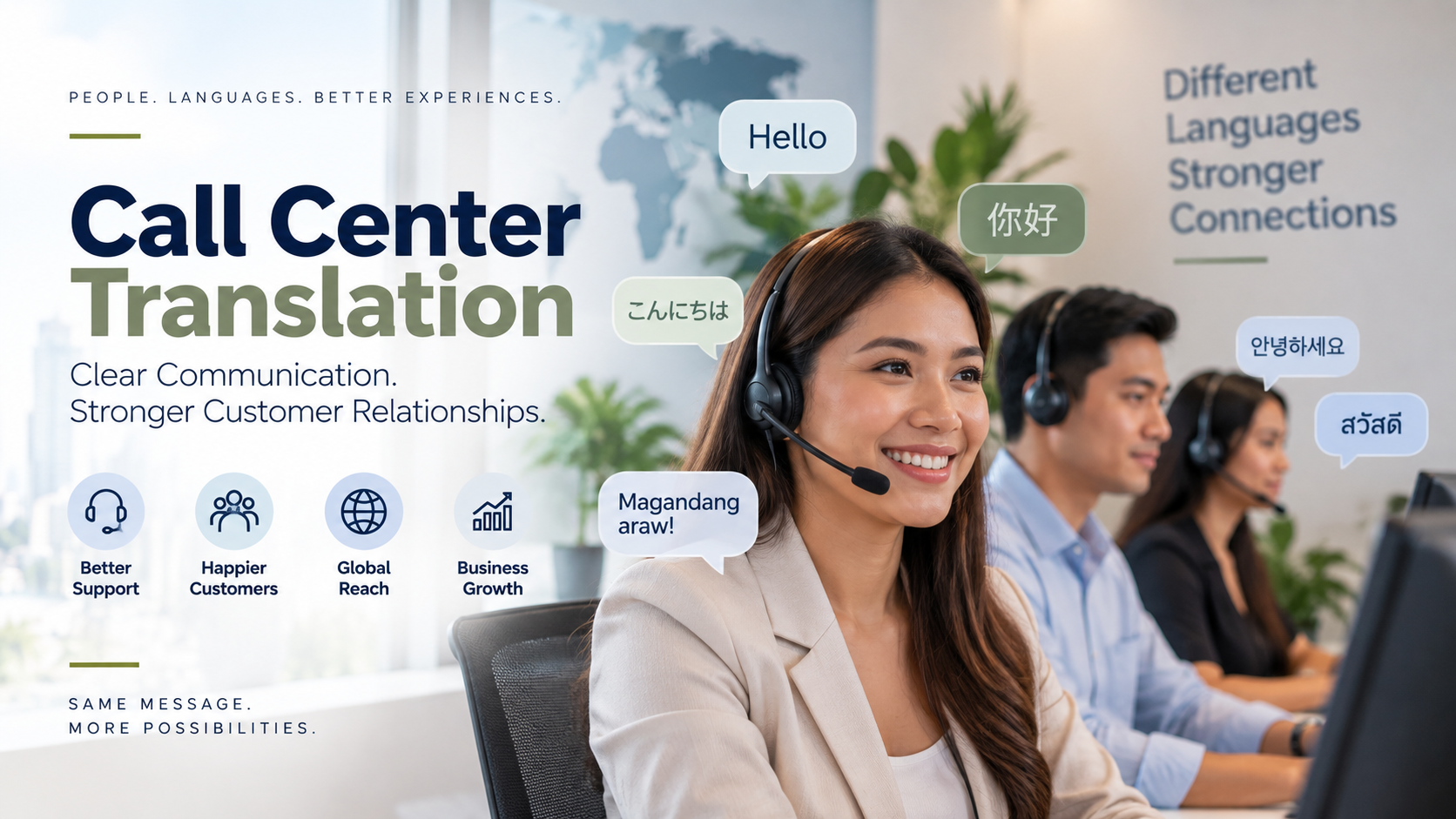
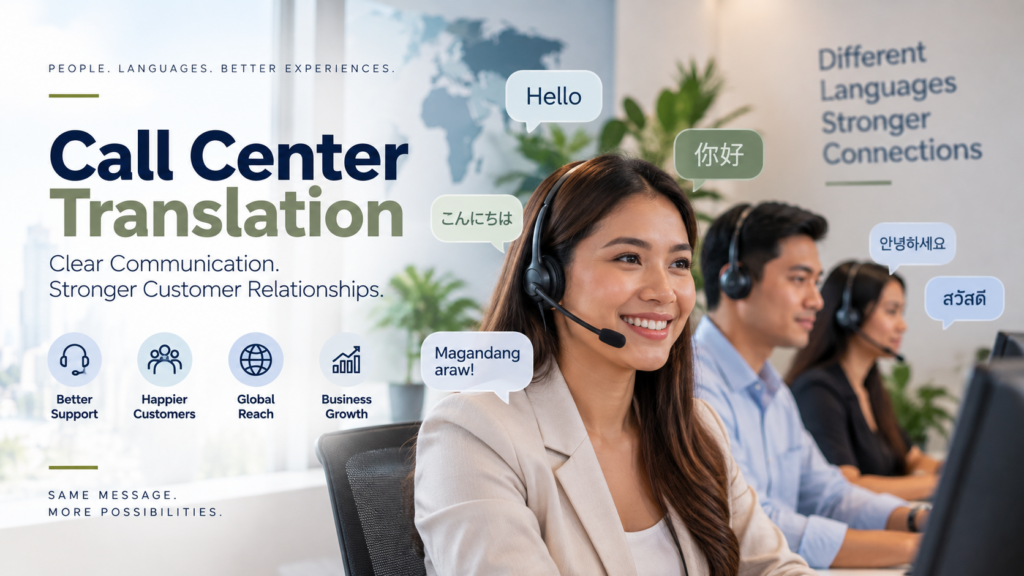
Call Center Translation: How Can Businesses Support Customers in More Languages?
A customer contacting a company does not want to feel like they are solving a language problem before they can solve their actual problem.
That is why multilingual customer support has become increasingly important for businesses serving international audiences.
Call center translation can help companies adapt customer service scripts, knowledge bases, FAQs, chat content, email responses, training materials and other support resources for different languages.
But there is an important distinction.
Good call center translation is not simply about translating a script.
It is about preserving the intent, tone and usability of the communication.
1. What is call center translation?
Call center translation refers to the adaptation of customer service content into different languages so agents and customers can communicate more effectively.
This can include:
Customer service scripts
Frequently asked questions
Knowledge bases
Email templates
Chat responses
Product information
Troubleshooting instructions
Training materials
Internal procedures
Customer satisfaction surveys
Website support content
Depending on the organization, language support may also include interpretation for live customer interactions.
The goal is to create a consistent customer experience regardless of the language being used.
2. Why is ordinary translation not always enough?
Imagine a customer service script originally written in English:
“I’m sorry you are experiencing this issue. Let me see what I can do to help.”
A literal translation may communicate the basic meaning.
But professional customer service localization considers how people actually expect support representatives to communicate in the target market.
Tone matters.
Formality matters.
Cultural expectations matter.
Even terminology can matter.
A financial institution, healthcare provider and software company may all use different communication styles with customers.
This is why call center translation should be connected to the company’s broader communication strategy.
3. Consistency is one of the biggest challenges
Large customer support organizations may have thousands of approved responses.
If different translators use different terminology, the customer experience can quickly become inconsistent.
One document may use one term for a product feature while another uses a different expression.
This is where terminology management and translation memory become valuable.
The European Commission, for example, uses translation memories to retrieve previously translated content and improve consistency and efficiency across large multilingual workflows.
The same principle can benefit commercial customer support.
A consistent multilingual terminology base can help ensure that product names, technical terms and customer service language remain stable across channels.
4. Call center translation and localization
Translation answers the question:
“What does this say in another language?”
Localization asks a broader question:
“How should this communication work for this audience?”
For customer support, the second question is often more important.
A localized support experience can account for cultural expectations, tone, terminology, examples and communication conventions.
This becomes especially important for businesses operating across Asia, Europe, Africa and other multilingual markets.
5. Where does AI fit?
AI and machine translation can help organizations process large volumes of customer communication.
They can be useful for certain internal workflows, high-volume content and first-pass translation.
But customer-facing communication can carry reputational consequences.
A poorly translated support response can confuse a customer, create frustration or damage trust.
For sensitive, technical or high-value communication, human review remains important.
ISO 17100 defines requirements for core translation processes, resources and other aspects involved in delivering quality translation services. The standard specifically distinguishes translation from interpreting and does not cover interpreting services.
6. What should businesses look for?
When selecting a call center translation provider, consider:
Industry expertise
Does the provider understand your products and customers?
Terminology management
Can they maintain consistent terminology across large volumes of content?
Quality assurance
Is translated content reviewed before delivery?
Localization
Can the provider adapt customer communications rather than simply translate them?
Scalability
Can the provider support multiple languages and changing volumes?
Security
How is sensitive customer information handled?
Technology
Can the provider work with your existing content and workflow systems?
Conclusion
Call center translation is ultimately about customer experience.
A multilingual customer should receive the same level of clarity, respect and support as every other customer.
That requires more than literal translation.
It requires linguistic expertise, terminology consistency, localization and quality control.
For organizations building multilingual communication workflows, Etranslation’s translation services can support multilingual business content across industries and communication channels.
Are you looking for a trusted partner, talk to us!
Comments are closed