Transcription Services Philippines for English, Tagalog and Taglish
Etranslation turns audio and video recordings into written text in English and Tagalog, including Taglish, where speakers switch languages mid-sentence. You pick verbatim or clean-read style, and decide if you want timestamps or speaker labels. Send the files and we quote the scope and the schedule before any work starts.
Most people hunting for transcription services philippines providers already have a recording on their phone and no idea what to ask for. Etranslation writes out interviews, meetings, calls and lectures in English, Tagalog or a mix of both. Below you’ll find the choices that shape a transcript, how it differs from translation and subtitling, what drags accuracy down, and how we handle your files.
What we transcribe
Anything with speech in it. Research interviews are the classic case, but we also get focus group recordings, board meetings, webinars, call center audio, podcasts, training videos and hearings that need a written record, from one ten-minute clip to a whole season of episodes.
Language is where it gets interesting. Plenty of Filipino speakers move between Tagalog and English without noticing, sometimes three times in one sentence, and that mix is Taglish, which a transcriber who only knows one of the two languages will stumble over within the first few minutes of a recording. Ours are Filipino linguists based in the Philippines, so the switching reads as normal speech rather than an error to fix.
Need another language? We cover 89, or 210 with regional variants. Audio availability gets confirmed when you send the file.
Verbatim or clean read: pick your style
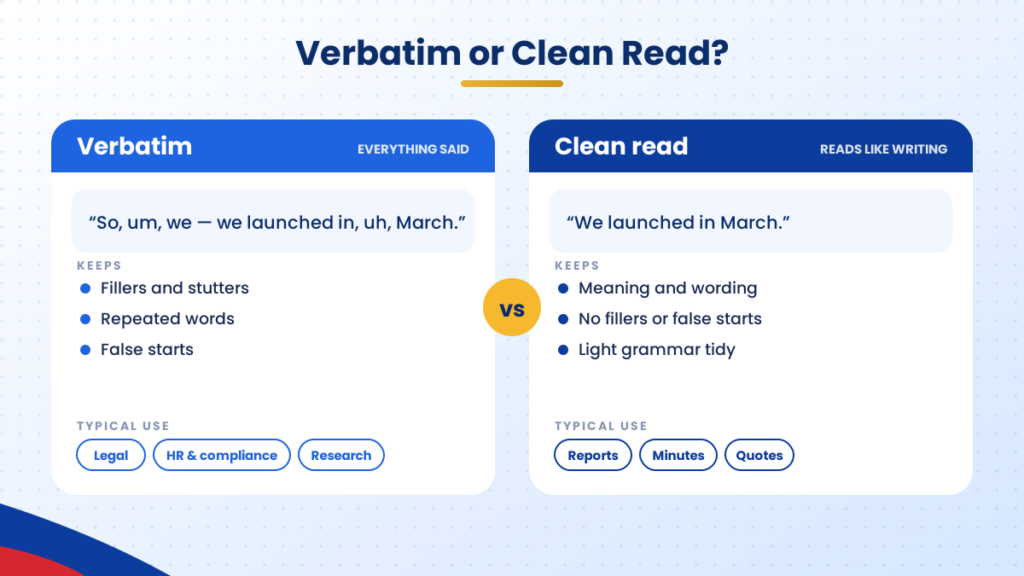
This is the first decision, and honestly it matters more than anything else on the spec sheet. A verbatim transcript keeps everything the speaker said: the false starts, the repeated words, the “um” and “ano” fillers. A clean-read transcript removes those and tidies the grammar lightly, so it reads like writing.
| Style | What it keeps | Typical use |
| Verbatim | Fillers, stutters, repeated words, false starts, non-speech sounds if you ask for them | Legal, HR and compliance records; linguistic or behavioral research |
| Clean read | The meaning and the speaker’s wording, minus fillers and false starts | Articles, reports, meeting minutes, quotes for publication |
Not sure? Tell us the purpose. If lawyers might read it, go verbatim. But if a marketing team is only mining it for quotes and nobody needs the ums, clean read saves everybody an editing pass and usually makes the finished text far easier to skim.
Timestamps mark where you are in the recording, say every minute or at each speaker change, so you can jump back to the audio. Speaker labels name who is talking, either by real name or as Speaker 1 and Speaker 2. For an interview with two people, labels are almost always worth it. For a lecture by one person, skip them.
Transcription, translation, subtitling and captioning
These four get mixed up constantly, and we see requests worded the wrong way round every week. Here’s the short version.
• Transcription writes down what was said, in the same language it was spoken.
• Translation changes written text from one language into another. If you need a Tagalog interview in English, that’s a transcript first and then a translation of it. See our translation services for the second step.
• Subtitling puts translated or same-language text on screen, timed to the speech and trimmed to fit reading speed. Our subtitling service handles that.
• Captioning is similar but also describes sounds, like music or a door slam, mainly for viewers who can’t hear the audio.
The order matters. A clean transcript makes the later steps cheaper and less error-prone, since the translator or subtitler works from fixed text instead of guessing at mumbled words. If you already know you’ll need English from a Tagalog recording, say so up front. Our page on Tagalog to English translation explains how that second stage works.
What affects accuracy
We won’t quote you a percentage, because anyone who does is guessing before they’ve heard your file. What we can tell you is what makes a transcript harder to produce, and most of that is in your hands, so it pays to look at it before you record anything at all.
• Audio quality. A phone on a café table picks up cutlery and traffic along with the voices. A headset mic in a quiet room is a different job entirely.
• Overlapping speech. Two people talking at once can’t be fully recovered, whoever is listening. Expect tagged gaps where it truly is unclear.
• Accents and speed. Fast talkers and strong regional accents take longer.
• Specialist terms. Medical, legal or technical vocabulary is far easier with a glossary or a list of names before work begins.
• Proper nouns. Company names and the names of people or places are the usual casualties, so send the spellings.
Where a word can’t be made out we mark it rather than invent something plausible, because a flagged gap is a minor annoyance while a confident, wrong quote sitting in your final report can undermine the whole project and everyone’s trust in it. Nobody spots those.
How your files are handled
Recordings often hold personal information, including names, voices, health details and opinions that people expected to stay private, and that deserves care from the moment you hit send, long before anyone starts typing.
The Philippines has a law covering this. Republic Act 10173, the Data Privacy Act of 2012, governs how personal data is collected and processed, and the National Privacy Commission explains the practical side at privacy.gov.ph. If your recording includes other people’s data, you may need their consent or a data sharing agreement on your side too. Check with whoever manages privacy at your organization.
On our end, send us only what the job needs. Trim long recordings to the relevant section if you can. If your project has confidentiality terms, a non-disclosure agreement or special storage rules, raise them when you request the quote so we can confirm what’s possible. We won’t promise anything we haven’t agreed in writing.
Prepare before you send
Ten minutes of prep can save a revision round. Gather this first:
• The recordings in their original format, not a compressed copy from a chat app.
• Total running time, and the number of speakers in each file.
• The languages spoken, with a note on Taglish if it applies.
• Verbatim or clean read, plus a yes or no on timestamps and speaker labels.
• Names, company terms and acronyms, spelled correctly.
• What the transcript is for, and who reads it.
• Your deadline, and whether a translation or subtitle file follows.
How the quote works
1. Send your files, or a short sample if they’re very large, through the quote form or by WhatsApp at +63 928 268 2435.
2. We listen to the audio and check the languages, the sound quality and the speaker count.
3. You get a quotation in under an hour after we receive the files. It spells out the scope and style, the file format and the schedule.
4. Once you approve, a Filipino linguist transcribes the recording and a second person checks the text against the audio.
5. You receive the finished transcript in the file format agreed in the quote.
Details such as file formats, large-volume handling and the schedule aren’t fixed on this page because they depend entirely on your recordings, so they’re all confirmed in your quotation before anything starts. If you need a live speaker rather than a recording, see our interpretation options instead.
Frequently asked questions
Can you transcribe Tagalog and Taglish recordings?
Yes. Our linguists are Filipino and based in the Philippines, so Tagalog and English come naturally, and so does mixed Taglish speech. Tell us how you want English terms handled inside Tagalog sentences, and whether to follow a house spelling. We’ll confirm the approach in the quote before starting.
What is the difference between verbatim and clean transcription?
Verbatim keeps every filler and stutter, plus each false start, exactly as spoken. Clean read removes them and lightly tidies grammar while keeping the speaker’s meaning. Legal and research projects often need verbatim. Reports and meeting notes usually work better as clean read. Tell us the purpose and we’ll recommend one.
Is transcription the same as translation?
No. Transcription writes speech down in the language spoken. Translation converts text into another language. A Tagalog interview you want in English needs both: first a Tagalog transcript, then a translation. Splitting the work this way keeps the source text fixed and makes the translation easier to check.
Can you add timestamps and speaker labels?
Yes, both are optional. Timestamps can be placed at set intervals or at each change of speaker, so you can find the matching spot in the audio. Speaker labels can use real names or simple tags like Speaker 1. Say what you want when you request the quote.
How accurate will my transcript be?
It depends on the recording, so we don’t promise a figure. Clear audio with one speaker at a time goes smoothly. Background noise, overlapping voices and heavy accents take more effort. Where a word can’t be made out, we mark it instead of guessing. Sending a short sample first helps us judge.
How is my recording kept private?
Share only what the project needs, and tell us about any confidentiality terms when you ask for a quote. We’ll confirm what’s possible in writing. If the audio contains personal data, the Philippine Data Privacy Act may apply to you as well, so check consent and agreements on your own side.
No responses yet