To Keep In Mind about Translation
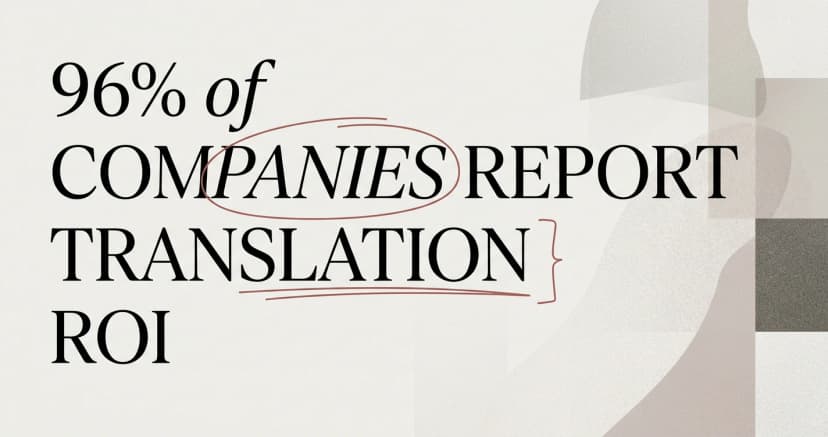
- In a survey cited by DeepL, 96% of companies reported positive ROI from localization and 65% reported returns of 3x or greater.
- The biggest cost of poor translation is invisible: abandoned customers, failed onboarding, and rework caused by miscommunication.
- An embedded multilingual layer sits inside your workflows, while a traditional vendor waits at the end of them.
- AI-assisted workflows speed delivery, but human linguists still own accuracy for regulated, high-stakes content.
- Choose a provider on security, subject-matter expertise, turnaround, and how well they integrate with your systems, not on per-word price alone.
The return on translation services comes from what you stop losing: customers who leave because they cannot understand you, clinical instructions that get misread, and onboarding that stalls because half the team is guessing at the other half. In a survey cited by DeepL, 96 percent of companies reported positive ROI from localization, and 65 percent reported returns of three times or greater (LocalizeJS). Translation services pay off when they are treated as an operational capability rather than a line item, and 2026 is the year that distinction starts to separate the organizations that scale across borders from the ones that keep tripping over language.
This piece breaks down where that value actually comes from: the hidden cost of miscommunication, what modern language work now includes, how an embedded multilingual layer differs from a traditional vendor, where AI belongs in the workflow, and how to choose a provider without getting distracted by the wrong numbers.
The Hidden Cost of Miscommunication
Most teams can name the price of a translation project. Very few can name the price of the misunderstanding it was meant to prevent.
Consider a decentralized clinical trial running across five countries. A patient misreads dosing instructions because the translation was literal instead of clinically accurate. That single event can trigger a safety report, a protocol deviation, and weeks of regulatory back-and-forth. Or consider a global enterprise onboarding forty new hires across three regions on the same platform in one language. The people who cannot follow it quietly fall behind, support tickets climb, and productivity suffers for a quarter before anyone connects the dots.
These costs rarely show up on a translation invoice, which is exactly why they get ignored. The market, though, is voting with its budget. According to the Slator 2026 Market Report, the global addressable market for language solutions and AI reached USD 30.85 billion in 2025 (Slator). Organizations are spending at that scale because the alternative, silent failure spread across dozens of small interactions, costs far more.

What Modern Translation Services Actually Cover
The phrase “translation services” still makes many buyers picture a document going in one language and coming out in another. That picture is a decade out of date.
Modern language work spans a connected set of capabilities:
- Translation of documents, contracts, and technical material with subject-matter accuracy.
- Localization that adapts websites, apps, and campaigns to local expectations, from currency and tone to cultural cues.
- Real-time and remote interpretation for meetings, medical appointments, and cross-border coordination.
- Subtitling and voice-over for training video, marketing, and e-learning.
- Transcription that turns spoken content into accurate, searchable text.
The point of listing these together is that they are increasingly bought together. A media producer needs subtitling and voice-over. A healthcare organization needs medical interpretation and document translation. An IT or cybersecurity company needs software localization and secure handling of sensitive material. When these run through separate suppliers, quality drifts and coordination overhead grows. When they run through one coordinated layer, terminology stays consistent and the work moves faster.
Embedded Multilingual Layer vs. Traditional Vendor
A traditional vendor waits at the end of your process. You finish the content, send it out, wait, and receive it back. That model works for one-off documents. It breaks down the moment language becomes continuous: a product shipping weekly, a support desk fielding live questions, a trial enrolling patients every day.
An embedded multilingual layer works differently. It sits inside your operational workflows, combining professional linguists, multilingual coordinators, and AI systems so that language support is available where and when the work happens. This is the model Etranslation is built around: professional human expertise and AI working as a layer within an organization rather than a disconnected external service you queue up and wait on.
The practical differences matter for ROI:
- Speed. Live interpretation and continuous localization remove the send-and-wait cycle.
- Consistency. Shared terminology and context carry across every request instead of resetting with each new vendor ticket.
- Security. Sensitive healthcare, legal, and cybersecurity content stays inside controlled handling rather than scattering across ad hoc suppliers.
- Scalability. Adding a language or a channel is a configuration change, not a new procurement cycle.
The cost of getting this wrong is measurable. Common Sense Advisory research found that Fortune 500 companies investing in translation were 1.5 times more likely to see total revenue rise (Argos Multilingual). Investment correlates with growth precisely because embedded language capability removes friction from every cross-border interaction.
Where AI-Assisted Workflows Speed Delivery Without Losing Accuracy
AI is the most misunderstood part of this conversation. The useful framing is simple: AI handles volume and speed, humans own judgment and risk.
In a well-designed AI-assisted workflow, machine translation produces a fast first pass on high-volume, lower-risk content, translation memory reuses previously approved phrasing so nothing is retranslated twice, and human linguists review, correct, and sign off on anything that carries real consequences. The result is faster delivery on the bulk of the work and full human attention reserved for the material that needs it.
The line to watch is content risk. A product description and a UI string can lean heavily on automation. A drug interaction warning, a security incident report, or a legal clause cannot. This is why the “AI replaces translators” narrative misreads the market. The value is in the division of labor, with AI expanding capacity and humans protecting accuracy where an error would cost far more than the translation itself.

For regulated and high-stakes environments, healthcare, cybersecurity, and international organizations among them, that human checkpoint is not optional. It is the reason the ROI holds up under audit.
A Checklist for Choosing a Language Service Provider
Per-word price is the easiest number to compare and the least useful one to decide on. A cheap translation that abandons a customer or triggers a compliance issue is the most expensive option you can buy. Use this checklist to evaluate a language service provider on what actually drives returns:
- Security and data handling. Where does your content live, who can access it, and does the provider meet the compliance requirements of your industry?
- Subject-matter expertise. Do they staff linguists who understand your field, whether that is clinical trials, software, or cross-border finance?
- Service breadth. Can one provider cover translation, interpretation, localization, subtitling, and transcription so quality and terminology stay consistent?
- Turnaround and availability. Can they support real-time interpretation and continuous localization, not just batch document delivery?
- Quality assurance. Is there a defined human review step for high-risk content, with clear accountability for errors?
- Integration. Do they plug into your existing tools and workflows, or do they add another silo you have to manage?
- Measurable outcomes. Will they help you track revenue from new language markets, reduced rework, and faster onboarding rather than just invoicing volume?
Score prospective providers against these, weight the criteria that matter most for your risk profile, and the right choice usually becomes obvious. The cheapest bid rarely wins once the full cost of getting language wrong is on the table.
Make Language an Asset, Not an Afterthought
The organizations getting real returns from translation services in 2026 share one habit: they treat language as part of how the business runs, not as a task they hand off and forget. They measure the customers they keep, the onboarding that lands, and the incidents that never happen.
Start with your single highest-risk language gap, the market you are losing, the trial you are coordinating, or the team you are onboarding, and fix that one first with a provider that can measure the result. If you want to map where an embedded multilingual layer would remove the most friction across your operations, request language support from Etranslation and start with the workflow that is costing you the most today.
Frequently Asked Questions
What are translation services in a business context?
They cover far more than converting documents word for word. Modern translation services include localization, real-time interpretation, subtitling, transcription, and voice-over, coordinated so that meaning, tone, and compliance carry across every language and channel.
How do I measure the ROI of translation services?
Track revenue from newly served language markets, reductions in support tickets and rework, faster onboarding of multilingual staff, and avoided compliance or safety incidents. Compare these gains against the fully loaded cost of the service, not just the per-word rate.
Does AI make human translators unnecessary?
No. AI accelerates first drafts and repetitive work, but human linguists still handle nuance, cultural context, and high-stakes content such as medical, legal, and cybersecurity material where an error carries real consequences.
What should I look for when choosing a language service provider?
Prioritize data security, proven subject-matter expertise in your industry, realistic turnaround times, quality assurance processes, and the ability to integrate with your existing tools and workflows rather than operate as a disconnected external vendor.

 English
  French
No responses yet