
Legal Translation Services Philippines: Contracts, Affidavits and Court Papers
Etranslation translates contracts, affidavits, powers of attorney, court documents and corporate filings between English and Filipino, plus other languages. Linguists keep defined terms consistent, a proofreader compares source and translation, and files stay confidential. We translate what the document says. We don’t give legal advice or interpret the law.
Legal text punishes loose wording. A single “shall” turned into “may” changes an obligation, and nobody notices until a dispute lands on someone’s desk. If you need legal translation services Philippines lawyers and companies, or private individuals, can rely on for accuracy, the real questions are who translates, who checks and who sees your files. Here’s how we handle each of those, plus what to prepare before you ask for a quote, so that our first reply is a price and not a polite list of the pages that went missing from your scan and the stamps nobody photographed.
Documents we translate
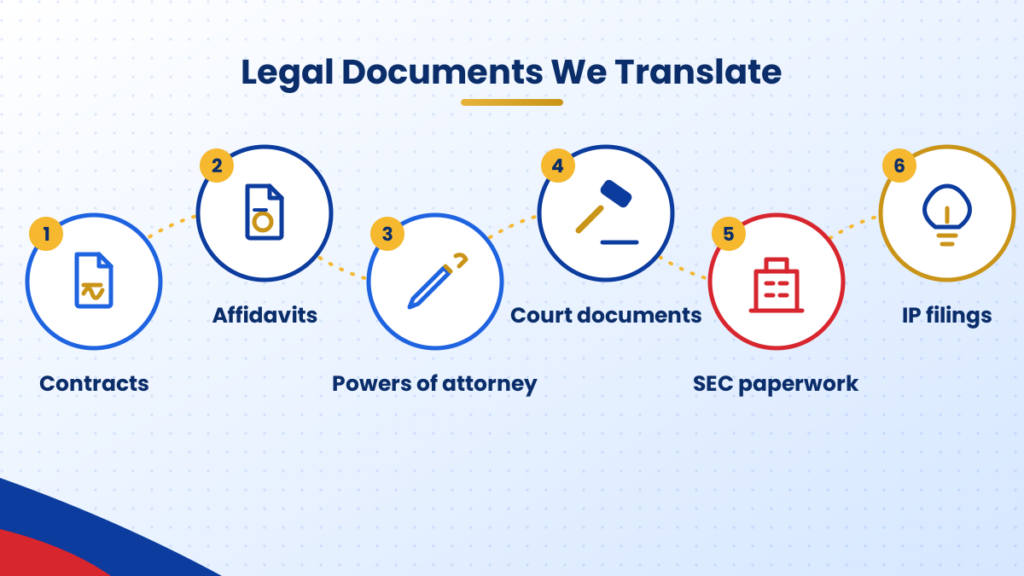
The requests that reach us most often are fairly ordinary paperwork with serious consequences attached:
• Contracts: service agreements, leases, employment contracts, NDAs, distribution deals.
• Affidavits and sworn statements, including affidavits of support or of discrepancy.
• Powers of attorney and authorizations, which tend to be short and very exact.
• Court documents such as complaints, orders, decisions, case summaries.
• Corporate and SEC paperwork: articles of incorporation, bylaws, secretary’s certificates, board resolutions.
• Intellectual property: trademark filings, license agreements, patent-related text.
Mixed bundles are normal. A company setting up a branch might send its articles, a lease and three authorizations together, and we treat the batch as one set so a party name reads identically everywhere. If the file is mostly forms and certificates, our document translation service covers formats and layout in more detail.
Why terminology consistency decides the outcome
Contracts define their own vocabulary. “The Company”, “the Licensee”, “Effective Date”: once defined, each must be translated the same way on page 2 and page 40. A translator who varies it for style has quietly created two meanings, and in a dispute the other side’s lawyer will happily point at the second one.
So before we start translating a long agreement, we pull out the defined terms and the recurring phrases and fix one rendering for each. Got a glossary from your counsel or a previous translation? Send it. Please. We’ll follow it. No glossary? We build a short list as we go and share it for approval, so your next batch matches this one.
Names get the same care. A party spelled “Ma. Cristina Dela Cruz” in one clause and “Maria Cristina de la Cruz” in another is a real problem in a contract, even though it’s the same person to a human reader. We keep the source spelling and flag the mismatch instead of fixing it silently.
Legal systems don’t map neatly onto each other
The Philippine legal system draws on both civil law and common law traditions, and many English-language Philippine contracts use terms familiar from common law practice. Easier, sometimes. Not portable. A term from one country’s system may have no exact twin in another, and a translator who invents an equivalent can mislead the reader.
Our approach is plain,. Where an equivalent exists and is standard, we use it, and where a court or agency publishes its own preferred wording in English or Filipino, we follow that wording if you send it to us. Where it doesn’t, we translate literally and, when it helps the reader, add a short translator’s note rather than force a false match. What a clause means for your rights or your case is a question for a lawyer qualified in the relevant jurisdiction.
What a translator can’t do for you
Honestly, this is where expectations go wrong most. A translator renders what a document says. We don’t advise if a clause is enforceable, if you should sign, or if a filing meets a court’s rules.
| Task | Translator | Lawyer |
| Render the contract faithfully in another language | Yes | Reviews if needed |
| Keep defined terms and names consistent | Yes | Supplies glossary if available |
| Advise on enforceability or risk | No | Yes |
| Decide what a court or agency will accept | No | Advises; the receiving body decides |
Ambiguous source sentence? We translate it as ambiguous and tell you, because making it clearer would mean changing the document, and a changed document is no longer the one your client or the court was originally given to read.
Certification, notarization and getting a quote
Many legal submissions want a signed statement that the translation is complete and accurate. We supply a certificate of accuracy signed by Arthur William Eyango, our CEO and a Registered Translator and Interpreter. What notarization or an apostille adds, and which one your receiving office wants, is covered in our guide to certified translation. Ask the office first, because rules differ from one court, registry or consulate to the next, and we can’t promise that any particular body will accept a given format, however carefully the certificate is worded.
Quotes depend on the word count, the language pair and how repetitive or technical the text is, so a lease with long boilerplate and a short affidavit full of names will be priced quite differently. Send scans or editable files and we reply with a quotation in under an hour after the files arrive. Our rates guide explains how a price gets built.
And the process on our side:
1. You send the files and tell us who will receive the translation.
2. We review the text, agree the scope and any glossary with you, then quote.
3. A Filipino linguist translates, with defined terms and names locked to the agreed list.
4. A proofreader compares the source and the translation line by line, hunting for omissions and number slips, plus names that don’t match the original spelling.
5. We deliver a PDF, a hard copy, or both. The certificate carries a QR code, and you can download it again later from our TranslatorsHub page.
That’s the translate-then-check pattern ISO 17100 describes, with a second person revising the work.
Confidentiality
Legal files hold things people don’t want circulated: salaries, deal terms, medical details inside a court record. Send us a document and you’re trusting us with it.
In the Philippines, the Data Privacy Act of 2012 governs how personal information is handled, and the National Privacy Commission publishes guidance at privacy.gov.ph. If your contract has its own confidentiality terms, or you need us to sign an NDA before you share files, tell us up front. Share only what the job needs. Redact an unrelated schedule if you like, but tell us.
Languages and what to send
Most legal work here runs between English and Filipino or Tagalog, in both directions,. Our Filipino linguists live in the Philippines. For other pairs we cover 89 languages, 210 with regional variants, and our Tagalog guide shows how we treat register in formal text.
Before you request a quote, gather these:
• Every page, in order, with stamps, signatures, handwritten notes: all visible. A scan cropped at the corner can hide a date, or the last digit of a case number.
• Editable files if you have them, since they save formatting time.
• Any glossary, previous translation or party-name list.
• The name of the court, agency or office receiving the translation, and its written requirements.
• Your deadline, counting any notarization time on top.
Ready? Use the quote form, or message us on WhatsApp at +63 928 268 2435.
Frequently asked questions
Can you translate a contract from English to Filipino?
Yes, in both directions. A Filipino linguist translates, defined terms stay consistent from the first page to the last, and a proofreader compares the result against your original. Send a glossary if your counsel has one. We translate the wording as written and don’t rewrite clauses or comment on their effect.
Do you give legal advice about the documents?
No. A translator renders what a document says, nothing more. Questions about enforceability, risk or what a court will accept belong with a lawyer qualified in the relevant jurisdiction. If something in the source text is ambiguous, we’ll flag it to you rather than resolve it ourselves.
Will a court or government office accept your translation?
That’s for the receiving court or office to decide, and we can’t promise it. Ask them for their written requirements on certification and format, then send those to us with your files. We’ll prepare the translation and certificate of accuracy to match them where we can.
How do you keep legal documents confidential?
We ask you to share only what the job requires, and we’ll agree extra terms or an NDA before files arrive if you need one. Personal data in the Philippines is covered by the Data Privacy Act, and the National Privacy Commission publishes guidance for anyone handling it.
Can you translate sworn statements and powers of attorney?
Yes. These are usually short but unforgiving, so every name, date and figure gets a line-by-line proofreading check against the original. We can attach a signed certificate of accuracy. Notarization or an apostille may be needed on top, depending on the receiving office, so confirm that with them early.
How much does legal translation cost?
It depends on word count, language pair and how technical or repetitive the text is. We review your files and send a quotation in under an hour after they arrive. No flat number would be honest without seeing the document, because a two-page affidavit and a sixty-page agreement are different jobs.
Comments are closed